
Cross-border payments · Stablecoins · Japan–Vietnam · Market entry
Fasset in Vietnam: validate the corridor before the consumer market.
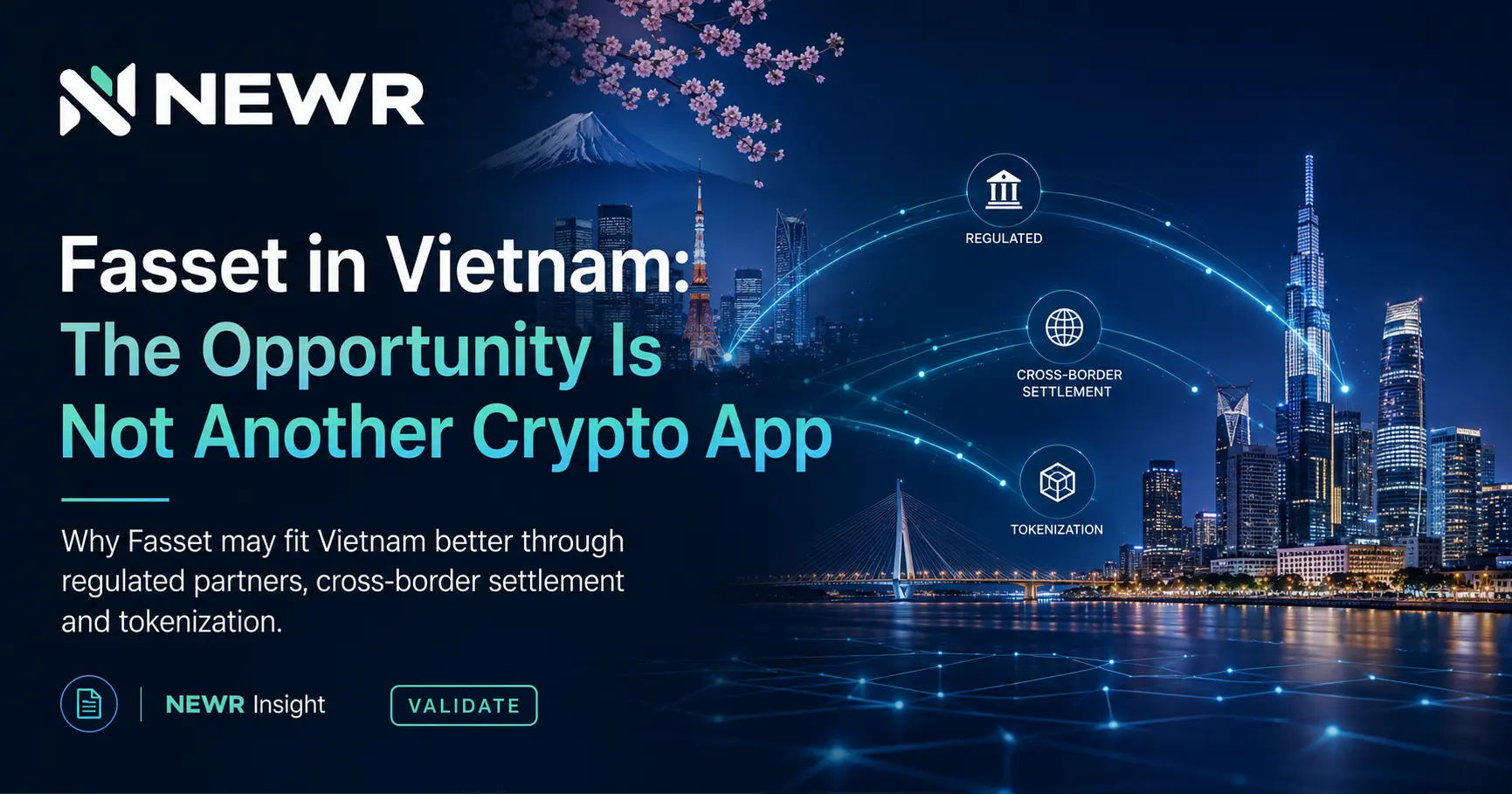
Fasset's strongest Vietnam opportunity may not be another retail crypto app. It may be the regulated payment and settlement infrastructure behind a specific cross-border corridor.
Executive thesis
The infrastructure may be more relevant than the app.
Fasset presents itself as a stablecoin-powered financial platform, but its more relevant Vietnam asset may sit behind the consumer interface. Own Network is designed to connect banks, payment companies, liquidity providers and other financial institutions across international markets.
That institutional architecture may fit Vietnam better than a retail-first launch. Fasset's current Card page lists Vietnam among the countries where its virtual card cannot be issued. More importantly, a consumer product would still need compliant local distribution, payment access and a reason for Vietnamese users to change existing financial behavior.
In Vietnam, Fasset should validate the corridor before validating the consumer market.
NEWR's initial hypothesis is therefore narrower: identify one economically meaningful flow, connect it to a licensed Vietnamese payout partner and test whether Own Network improves settlement speed, cost, transparency or capital efficiency.
01 · Entry model
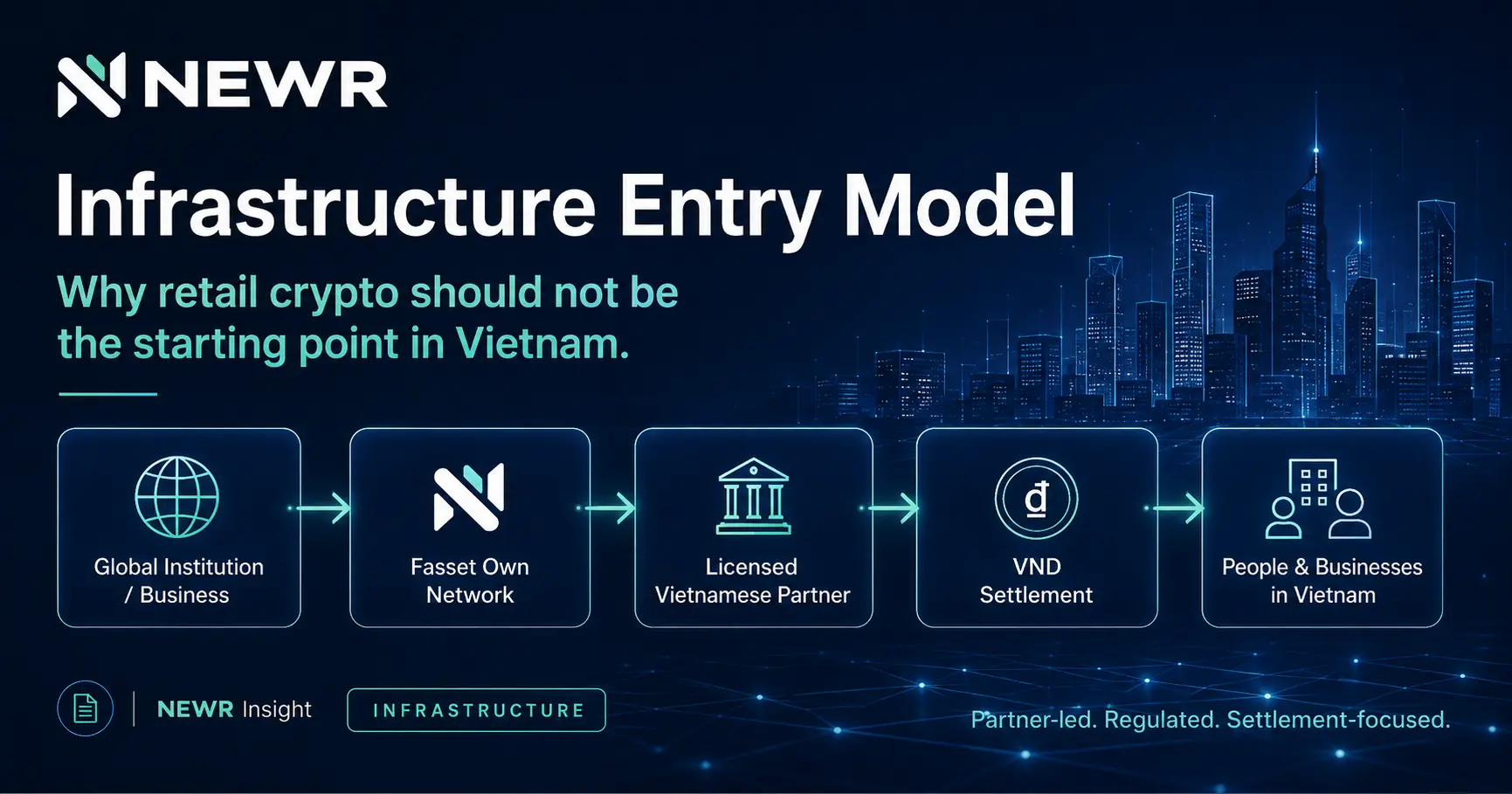
Start with regulated infrastructure, not mass retail acquisition.
SBI Group's August 2026 disclosure describes Own Network as connecting 16 blockchain networks and more than 100 banking corridors. Fasset's own announcement says the SBI Remit relationship is intended to support remittances, SME payments and treasury operations through stablecoin-powered infrastructure.
Network size and wallet figures are reported by Fasset or SBI Group. They are useful indicators of operating scale, but they should not be treated as independently audited performance figures.
The practical Vietnam model is partner-led: a regulated institution originates the payment, Fasset provides settlement infrastructure, and a licensed Vietnamese counterparty handles the local endpoint and VND payout. Fasset does not need to begin by acquiring a large retail audience or asking merchants to adopt a new consumer app.
02 · Initial corridor
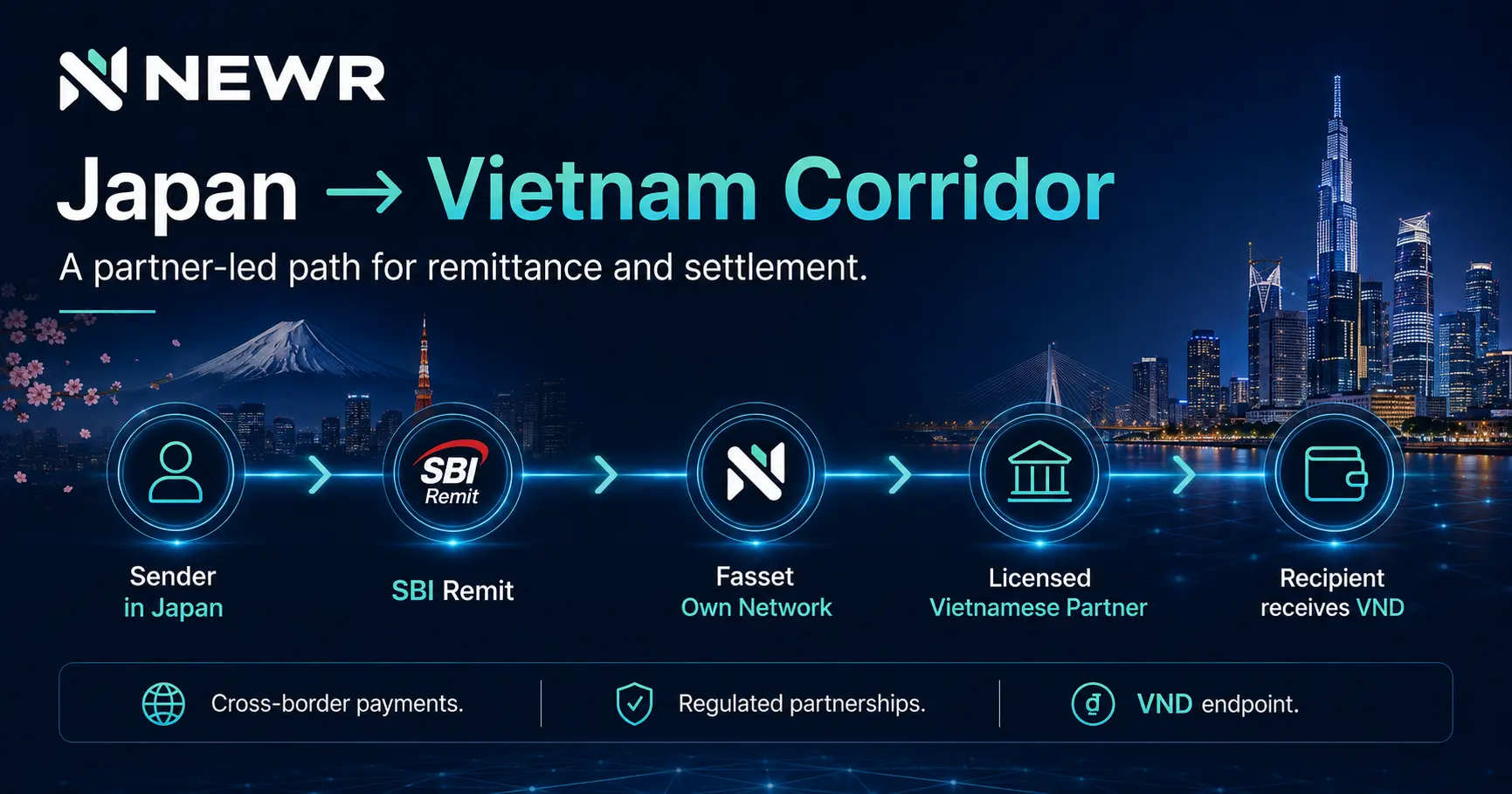
Japan → Vietnam is the most relevant first route to test.
Japan has a large and established Vietnamese resident community. Japan's Ministry of Foreign Affairs stated in April 2025 that approximately 630,000 Vietnamese people were residing in the country. This creates a visible base of workers, families and businesses with recurring financial links to Vietnam.
Fasset also has a concrete institutional starting point. SBI Remit and Fasset announced a partnership in June 2026 to explore next-generation international remittance infrastructure. SBI Group later disclosed additional investment in Fasset and its intention to deepen the companies' commercial relationship.
Fasset and SBI Remit have publicly announced cooperation on international remittance and stablecoin-powered settlement infrastructure.
What remains a NEWR hypothesisA live Japan–Vietnam route, the Vietnamese payout institution, commercial terms, settlement design and regulatory treatment have not been established by the public sources reviewed.
03 · Opportunity stack
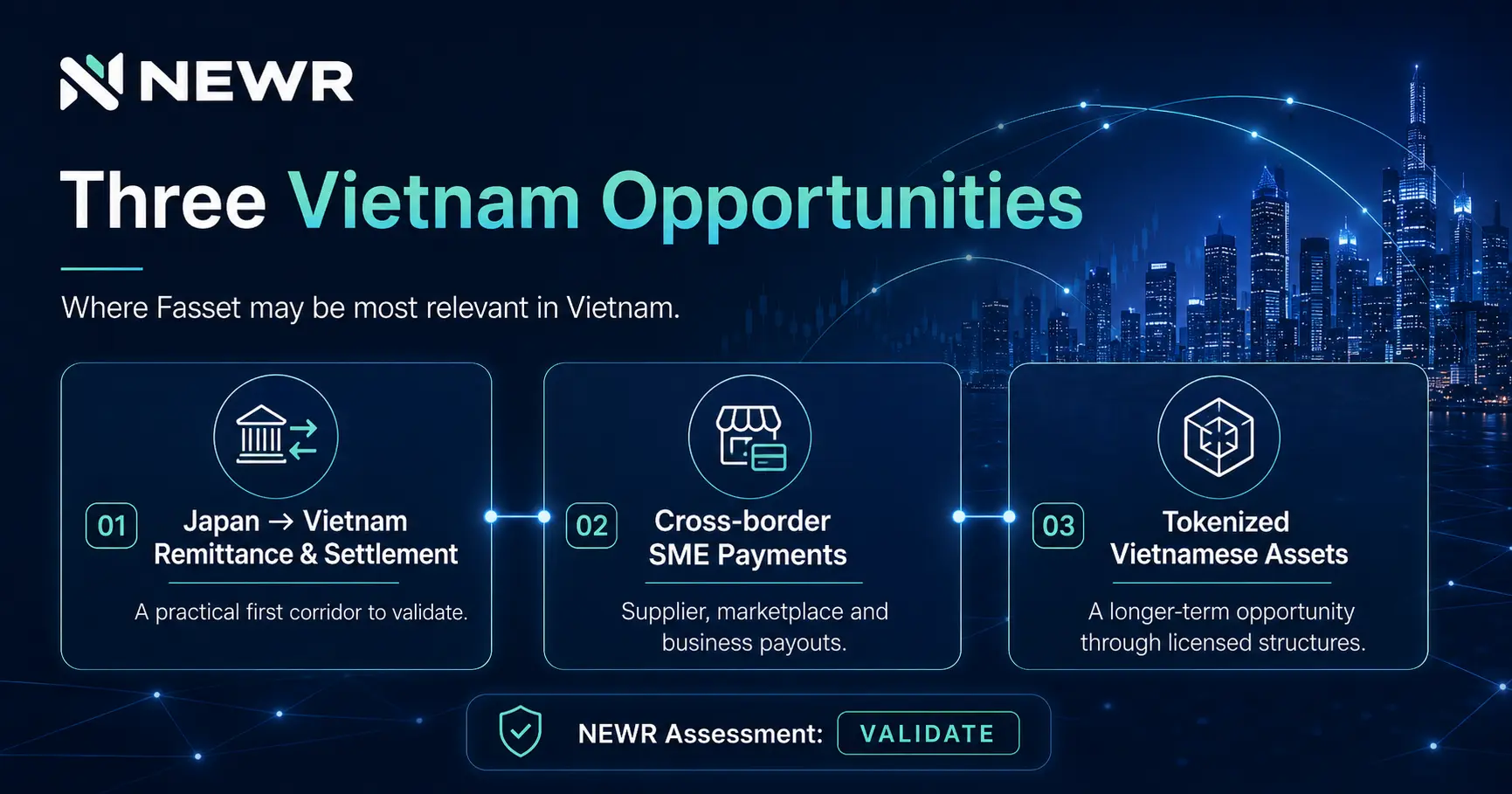
One corridor can open three levels of opportunity.
Remittance and settlement
Test one recurring Japan–Vietnam payment flow with clear sender demand, a regulated originator and a compliant VND endpoint.
First priorityCross-border SME payments
Extend the same infrastructure to supplier settlement, marketplace payouts, contractor payments and treasury operations.
Tokenized Vietnamese assets
Explore regulated real-world-asset distribution only after legal structure, custody, investor eligibility and settlement are validated.
The sequence matters. Remittance or B2B settlement can prove the corridor's operational value. Tokenization is a longer-term layer, not the reason to skip the harder work of validating licences, counterparties and transaction economics.
04 · Decision requirements
The key question is which partner makes the corridor workable.
A credible Vietnam route requires more than demand and settlement technology. The local operating model must define who receives cross-border funds, who performs KYC and AML checks, where stablecoin conversion occurs, who manages foreign exchange, which institution pays VND and how customer disputes are handled.
Which corridor and licensed local partner can make Own Network economically useful in Vietnam?
05 · Validation roadmap
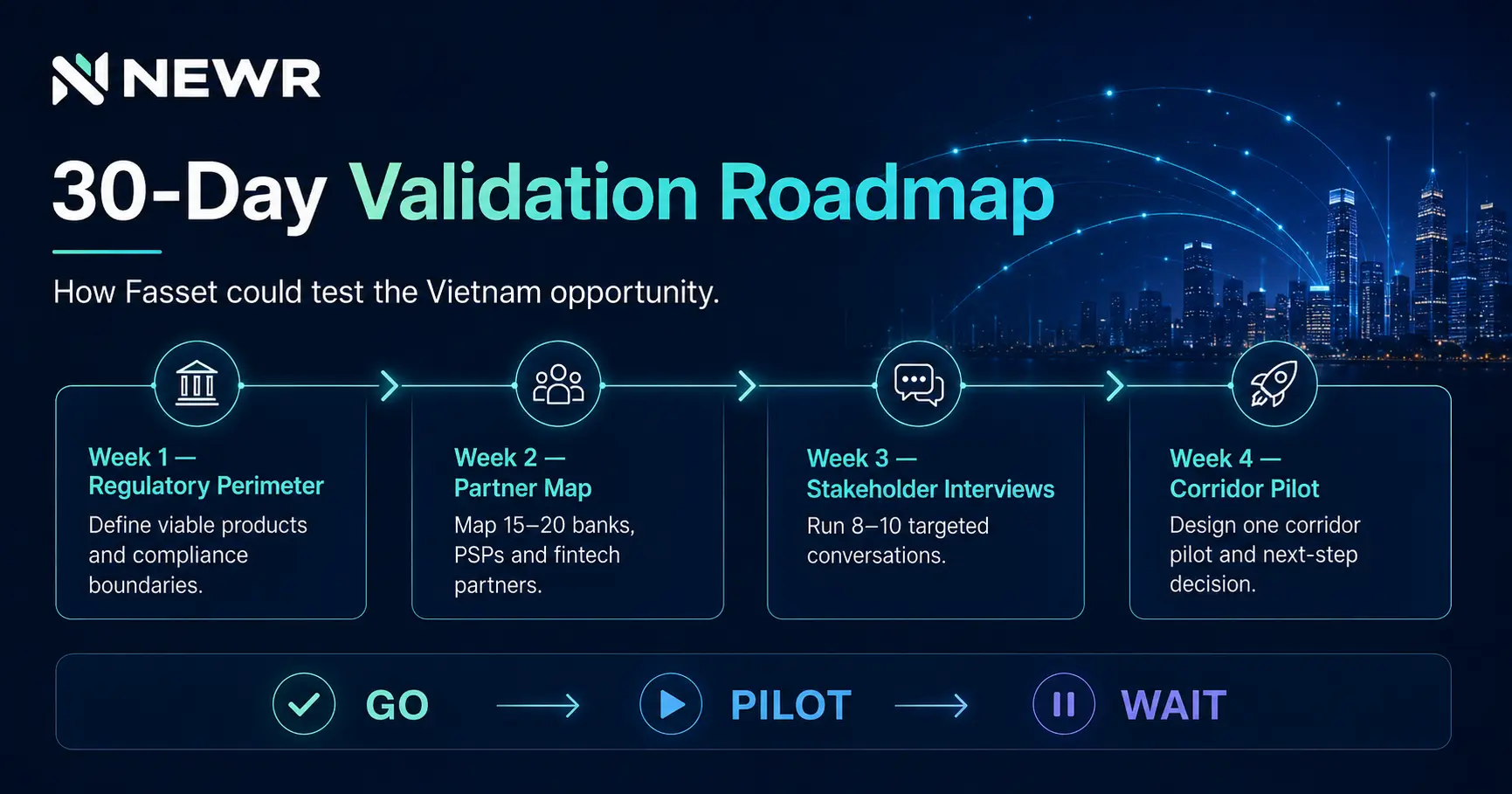
A 30-day path to a go, pilot or wait decision.
Define the regulatory perimeter
Map the viable product, entities, licences, settlement structure and compliance boundaries.
Build the partner map
Identify and score 15–20 banks, payment providers, remittance companies and fintech counterparties.
Interview the market
Run 8–10 targeted discussions to test partner appetite, operational constraints and corridor economics.
Design one corridor pilot
Specify the parties, user cohort, transaction flow, metrics, risks and next decision.
06 · NEWR assessment
Validate one corridor—not an entire consumer market.
VALIDATEFasset has a credible institutional reason to examine Vietnam: Own Network is built for cross-border settlement, SBI Remit provides a relevant Japan-based relationship and Vietnam is connected to Japan through a large resident and business community.
None of this proves that a Japan–Vietnam corridor is commercially or regulatorily ready. It does make the corridor a sharper first question than a broad consumer launch.
The opportunity is not simply entering Vietnam. It is finding the transaction flow where Fasset's infrastructure creates measurable value.
Vietnam Market-Entry Validation Sprint
One product. One corridor. One Vietnam decision.
Validate the regulatory perimeter, partner architecture, demand and pilot economics within seven business days.
View the validation sprintResearch record
Sources
- 01
- 02
- 03
- 04
- 05
- 06Ministry of Foreign Affairs of JapanJapan–Vietnam relations and the Vietnamese resident community in Japan — 27 April 2025 ↗
Research cut-off: 4 September 2026.