
PayFi · RWA · Payments · Vietnam Market Intelligence
Huma Finance, PST and the race to bring global payment flows on-chain.
Huma is not simply building another RWA product. Its more consequential thesis is that stablecoin liquidity can become working capital for global payments—and PST can become the on-chain asset built on those flows.

01 · The underlying problem
Cross-border payments are also a liquidity problem.
For years, the stablecoin discussion centered on a relatively simple question: can stablecoins move money faster? Huma Finance asks a larger one: what if stablecoins are not only a payment instrument, but also the working capital that allows financial institutions to execute payments?
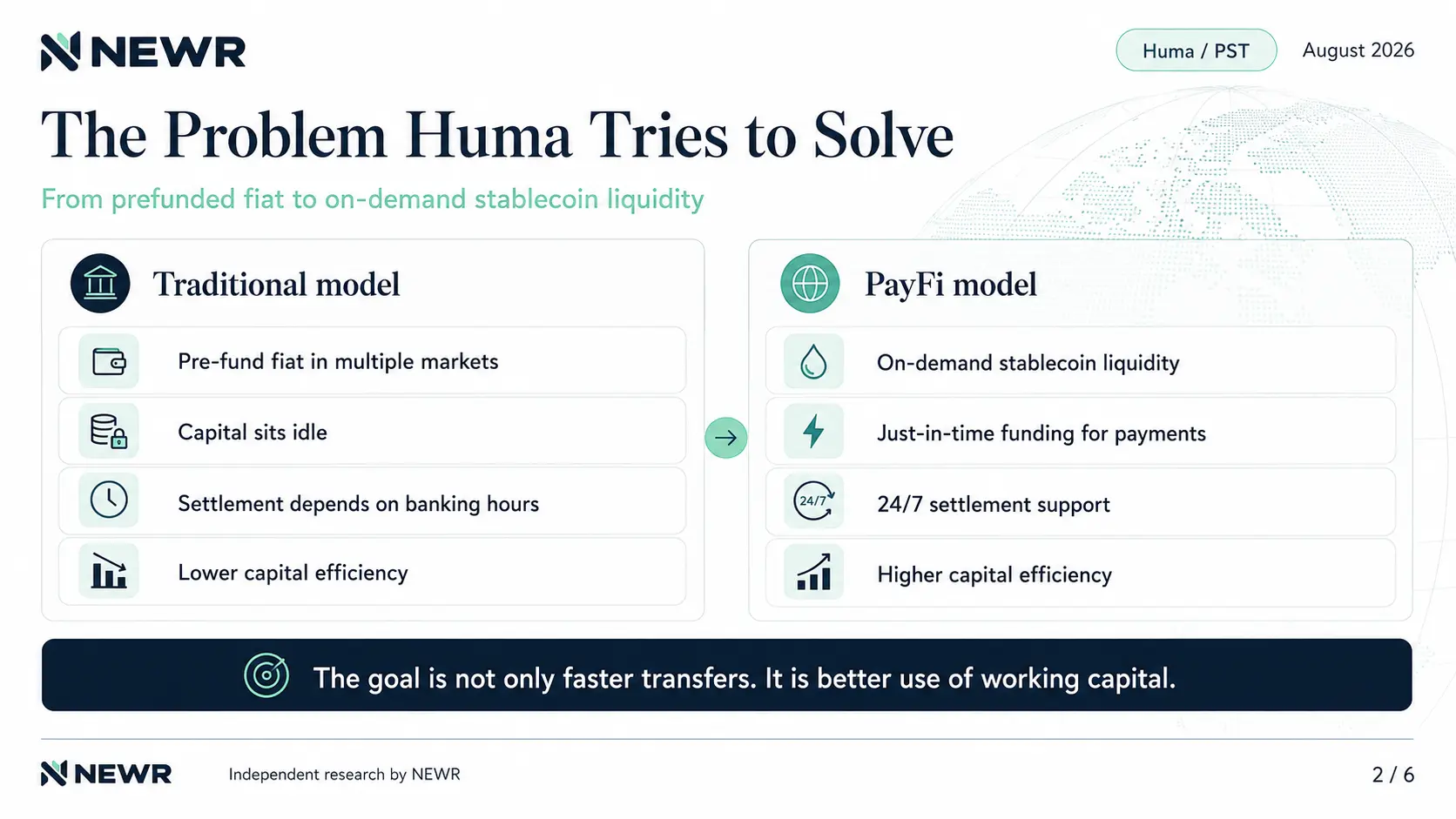
A payment company operating across markets often has to maintain balances in multiple local accounts so it can meet payout requests. A provider collecting funds in Singapore but paying recipients in VND may need to keep liquidity ready in Vietnam. Add the Philippines, Indonesia, Thailand or Mexico, and more capital must be parked across more markets.
Traditional model: prefund fiat, hold capital idle, then pay out. PayFi model: transaction demand, stablecoin liquidity, settlement, then repayment.
Capital appears when a transaction needs it. The model is closer to just-in-time liquidity than traditional prefunding.
02 · From concept to operating network
Huma is applying the model to real payment and trade flows.
According to figures published by Huma on 25 August 2026, its network has surpassed $17 billion in total transaction volume, is adding more than $1 billion each month, is growing at more than three times the prior-year rate and has recorded no credit defaults to date.
These are company-reported figures from Huma and should be distinguished from audited or independently verified financial statements. They nevertheless indicate that PayFi has moved beyond its initial concept phase.
Cross-border payment financing
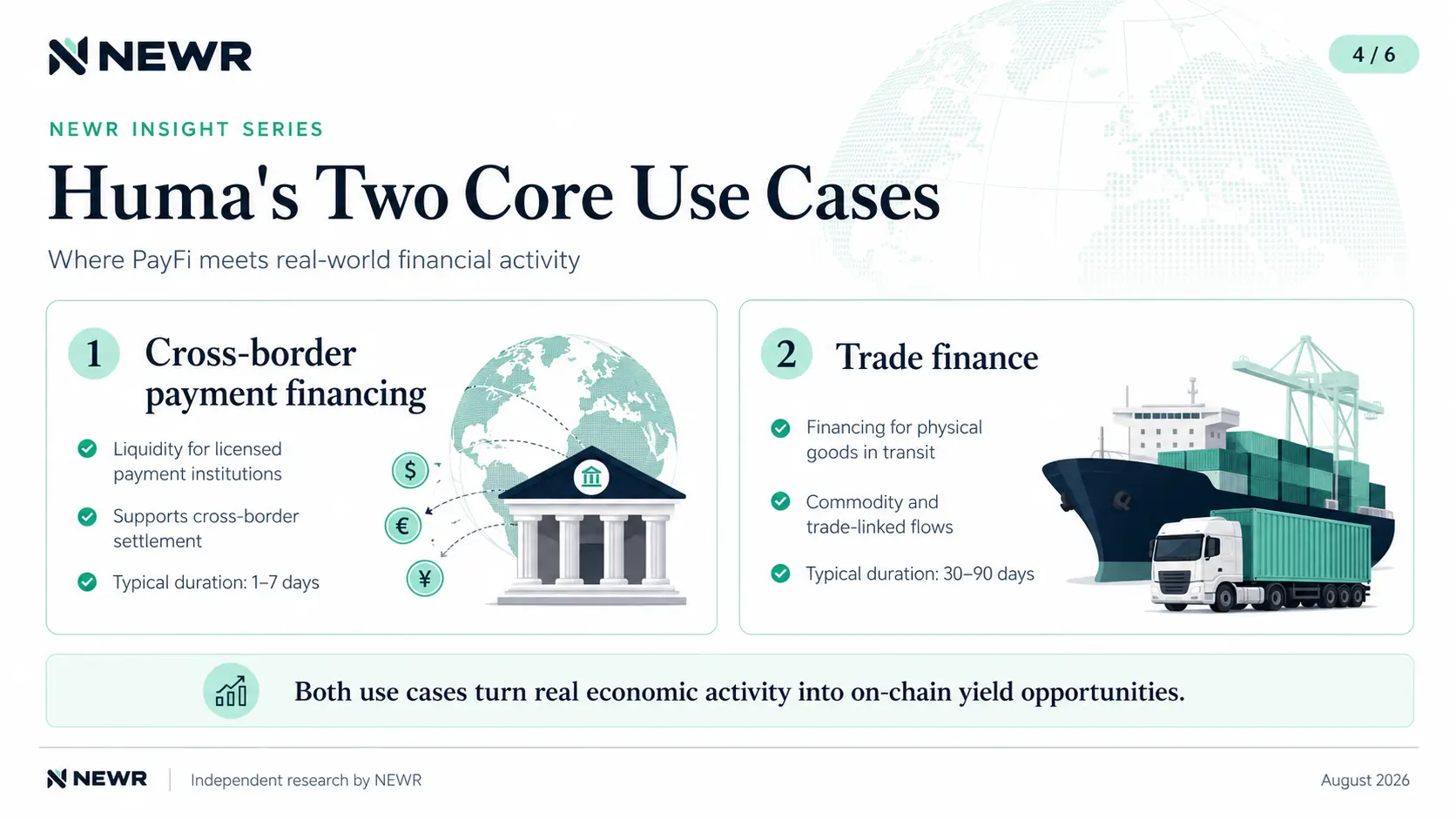
Through Arf, stablecoin liquidity is provided to licensed payment institutions so they can settle cross-border transactions without prefunding the full fiat requirement. Huma says these transactional credit facilities are typically repaid within one to seven days.
Arf Financial GmbH is incorporated in Switzerland and publicly identifies itself as a member of the VQF Self-Regulatory Organization, an SRO recognized by FINMA under Switzerland’s anti-money-laundering framework.
The core economics are not only about yield; they are about capital velocity. If $10 million finances transactions with an average five-day duration, that capital could theoretically revolve about 73 times in a year. Efficient reuse allows the same capital base to support payment volume many times larger than the capital committed.
Trade finance
Huma also extends the model to financing physical goods in transit through TradeFlow Capital Management in Singapore. TradeFlow describes itself as an institutional asset manager focused on commodity import-export finance and reports facilitating more than $5 billion of physical commodity trade.
Huma says transactions in this vertical typically run for 30 to 90 days. The tenor is longer than payment financing, but the exposure is still tied to commercial activity in the real economy.
Blockchain does not have to generate yield from the crypto market itself. It can distribute capital into activities that already exist off-chain.
03 · Product mechanics
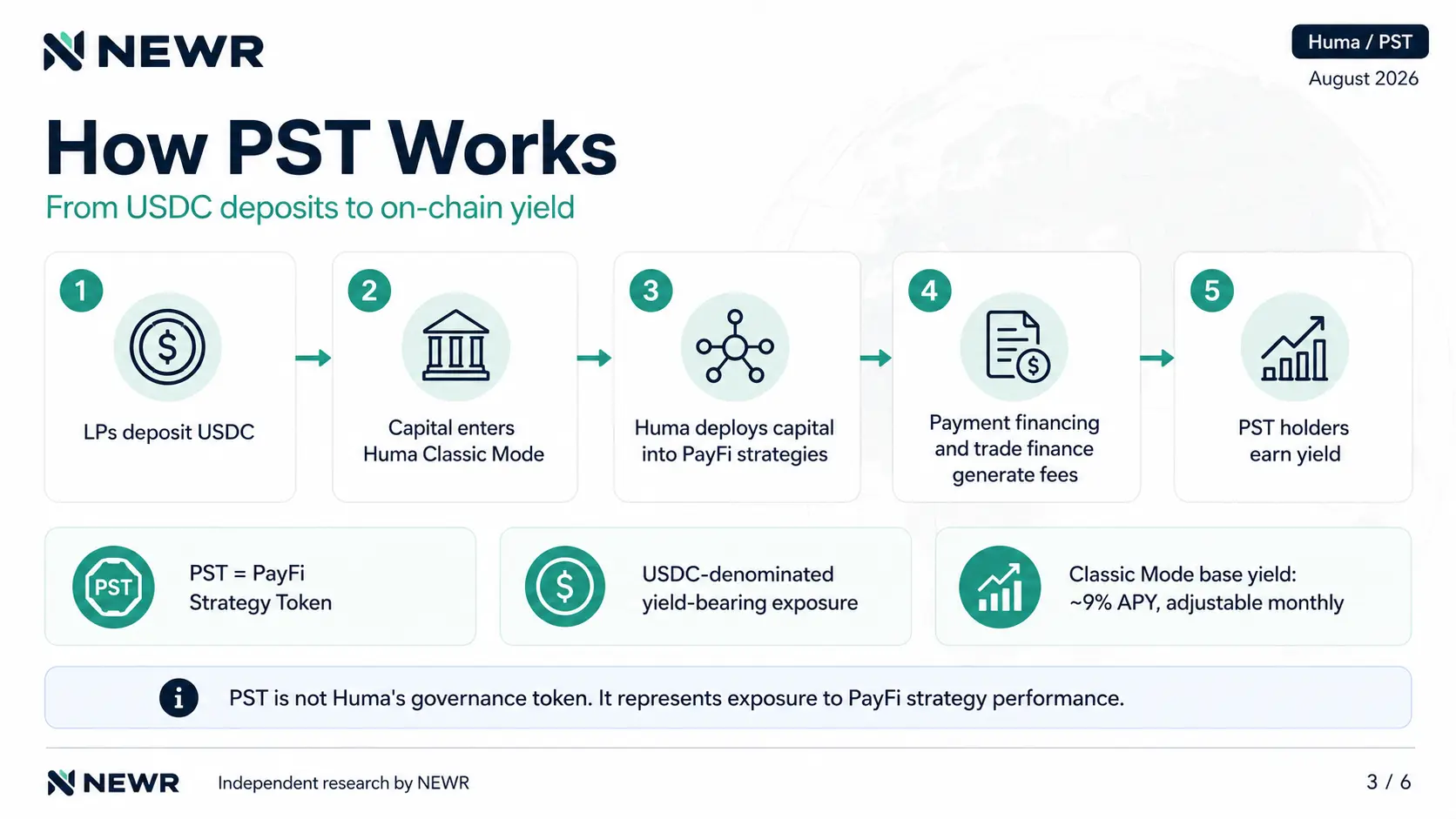
PST is not Huma’s governance token.
PST—PayFi Strategy Token—plays a different role from $HUMA, the governance and ecosystem token. In Huma Classic Mode, a liquidity provider deposits USDC into a Huma strategy and receives PST.
PST is an LP token representing the provider’s position in a PayFi strategy. Huma documentation described Classic Mode with a base yield of approximately 9% APY at the research cut-off, while noting that the rate may be adjusted monthly as market conditions change.
PST is therefore better understood as tokenized, yield-bearing credit exposure than as a conventional speculative utility token.
Where does the yield come from?
The critical question for any yield product is not the headline rate. It is who pays the yield, and why. In Huma’s model, capital is deployed into PayFi applications that finance cross-border settlement, payment flows, card-related receivables and trade finance.
This distinguishes PST from DeFi strategies whose economics depend mainly on token emissions. If the underlying payment activity persists, the theoretical source of yield need not depend entirely on rising crypto prices.
04 · Capital-market infrastructure
PST is being institutionalized beyond a single liquidity pool.
On 25 August 2026, Huma reported that PST had exceeded $220 million in market capitalization and ranked among the ten largest tokenized credit assets on RWA.xyz.
During 2026, PST infrastructure expanded across Jupiter, Meteora, Kamino, RateX, Morpho, Fluid and RockawayX. Huma also deployed cross-chain infrastructure using Chainlink CCIP and oracles.
An RWA token confined to one application has limited utility. An asset that can move across these functions begins to resemble broader capital-market infrastructure.
05 · The hardest RWA question
Blockchains can verify tokens—not the off-chain receivables behind them.
A blockchain can show that a token exists, where it sits, how many units were minted and which transfers occurred. It cannot, by itself, confirm that the off-chain receivable represented by the token exists or remains collectible.
Huma is addressing this structural weakness with an additional verification layer. PST uses Accountable for third-party verification of asset exposure and performance. Accountable uses cryptographic proofs to connect data from blockchains, custodians, exchanges and other financial sources without necessarily exposing all sensitive information.
Huma says this information is also cross-checked against monthly attestations by Swiss audit firm Wadsack.
Better verification improves visibility into assets and performance. It does not eliminate credit risk, guarantee repayment or make PST a risk-free savings product.
06 · Two different exposures
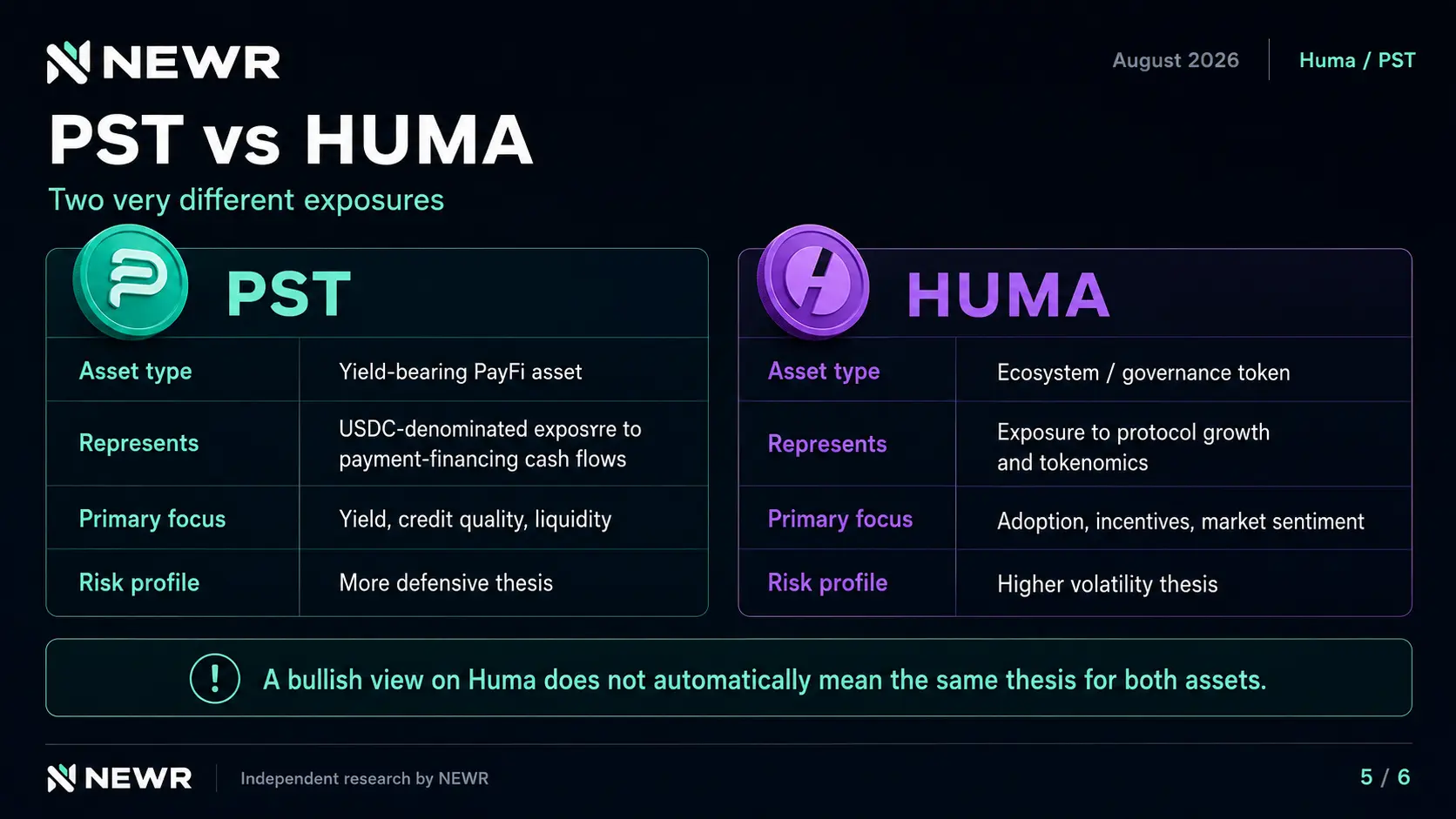
PST and HUMA require separate investment theses.
PayFi credit exposure
Primarily reflects credit quality, payment volume, yield, liquidity and the performance of underlying assets. Its risk profile is closer to credit and liquidity risk.
Protocol and token exposure
Reflects protocol growth, token economics, incentives, governance and market expectations. Its price can therefore be considerably more volatile.
A bullish view on the Huma protocol does not automatically produce the same thesis for both assets.
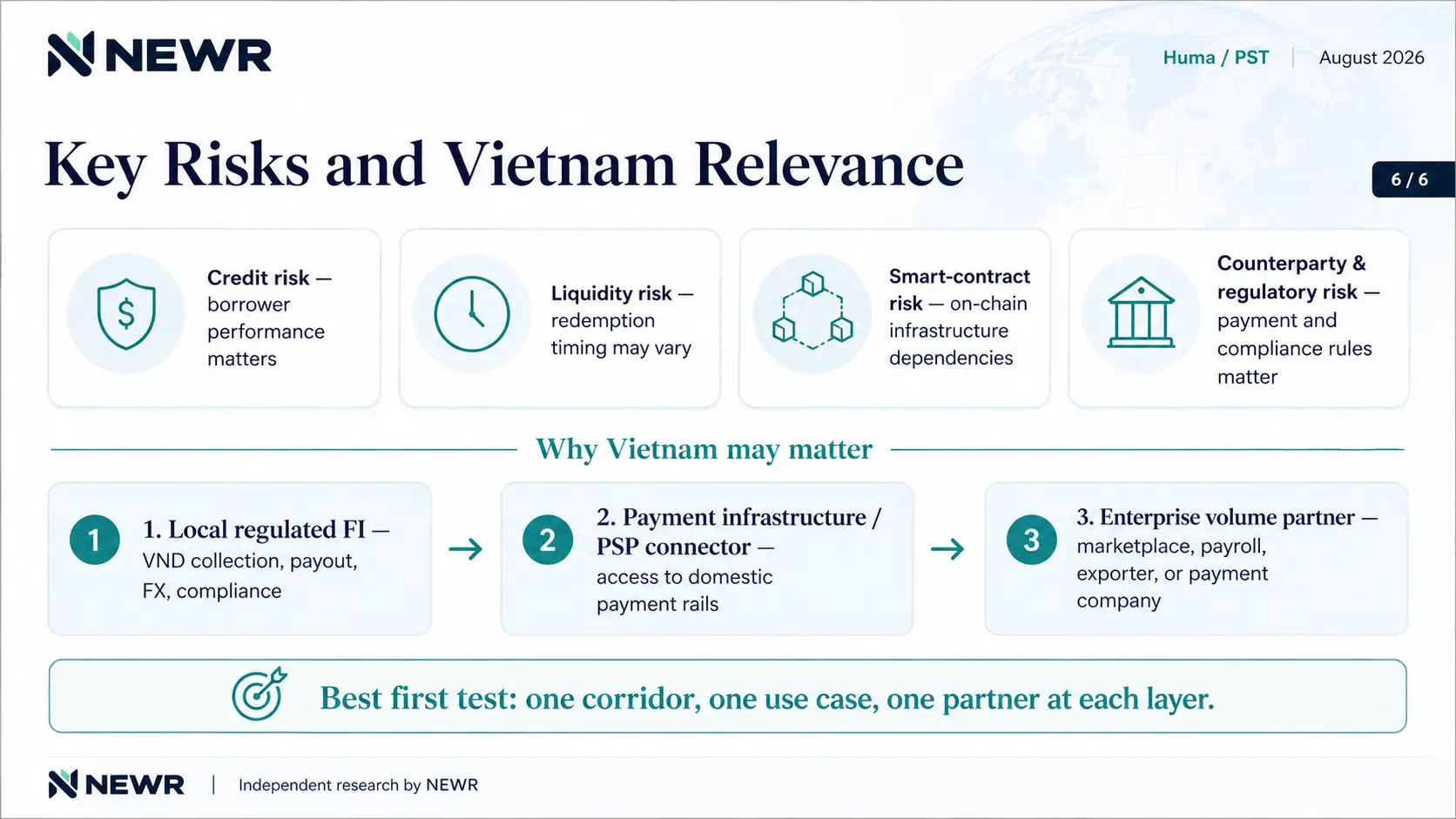
07 · Risk framework
A stablecoin-denominated yield is not risk-free.
Credit risk
A borrower or payment institution may fail to repay on time. A historical zero-default record does not guarantee future performance.
Liquidity risk
Underlying assets may not convert to cash immediately if many LPs redeem at once. Huma documents processing targets, an outer SLA and daily caps.
Secondary-market risk
DEX liquidity is not the same as NAV liquidity. Spreads may widen during a stress event.
Smart-contract risk
PST depends on smart contracts, bridges, oracle infrastructure and integrated protocols.
Counterparty risk
More payment companies, custodians and institutional partners create a more complex counterparty graph.
Regulatory risk
Payment financing sits at the intersection of payments, lending, stablecoins, securities and cross-border finance.
08 · Vietnam relevance
Vietnam may fit PayFi first as an enterprise settlement corridor.
Vietnam combines large import-export flows, cross-border commerce, remittance, marketplace settlement, outsourcing and international payroll. Demand for cross-border payments is real, while much of the infrastructure still depends on traditional banking rails.
Regional stablecoin adoption creates the possibility of new B2B settlement models even while retail crypto activity remains tightly regulated. This does not mean Huma is entering Vietnam. It creates a market-entry hypothesis worth testing:
Vietnam may be more relevant to PayFi as an enterprise payment and settlement corridor than as a retail crypto market.
Local regulated financial institution
VND collection, payouts, FX and domestic banking access.
Payment infrastructure connector
Connection to local payment rails and compliance infrastructure.
Enterprise transaction source
A marketplace, exporter, payroll platform or payment company generating real volume.
If all three layers exist, PayFi may solve a concrete problem: reducing working capital that must be prefunded for cross-border payments.
09 · NEWR assessment
The thesis worth watching is larger than a 9% APY.
WATCHHuma is attempting to turn short-duration real-world payment receivables into liquid on-chain financial assets. At scale, PayFi could bridge two capital systems that have historically operated apart: global payments and on-chain capital markets.
PST is one of the clearest current experiments in that model. Four variables deserve continued monitoring:
01 · Underlying asset transparency
Which receivables is PST actually financing?
02 · Credit performance
Can zero-default performance persist as the asset base scales?
03 · Liquidity under stress
How do redemption and secondary markets behave when many LPs exit together?
04 · Institutional participation
How much capital are announced partners providing, and under which structures?
The defining question is not “What is PST’s APY?” It is whether Huma can turn payment liquidity into a multi-billion-dollar institutional asset class.
Vietnam Market-Entry Validation Sprint
Testing a PayFi or stablecoin infrastructure thesis in Vietnam?
Validate one product, one use case and one target corridor or customer segment within seven business days.
View the validation sprintResearch record
Sources
- 01
- 02Huma DocumentationHuma 2.0: Modes — Classic vs Maxi ↗
- 03Huma DocumentationRedemption ↗
- 04Huma DocumentationIntegrations ↗
- 05Huma DocumentationSmart Contracts ↗
- 06Huma DocumentationSecurity & Audits ↗
- 07Arf Financial GmbHVQF SRO membership information ↗
- 08TradeFlow Capital ManagementCompany and trade-finance information ↗
- 09AccountableIndependent transparency dashboard for PST ↗
- 10
Research cut-off: 31 August 2026.