
Stablecoin payments · VietQR · Vietnam market entry
RedotPay in Vietnam: VietQR is the entry point, not the moat.
A market-readiness analysis of stablecoin-funded local payments, Vietnam's QR infrastructure, regulatory boundaries and the next layer of transaction growth.
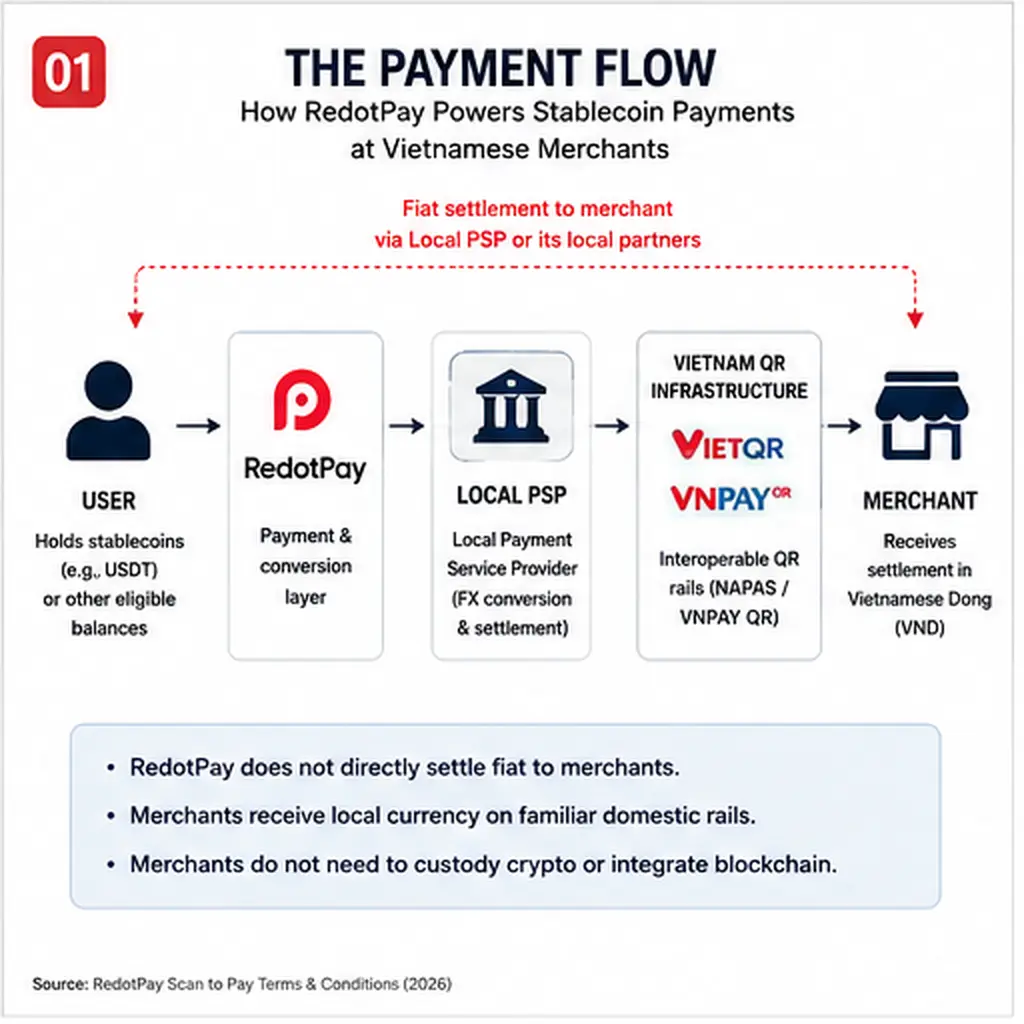
RedotPay continues to document VietQR and VNPAY QR support, but its official maintenance notice says payments to Vietnamese merchants are temporarily paused. Availability should be re-checked before operational use.
Executive thesis
Technical access is proven. The market is not.
RedotPay has crossed an important threshold in Vietnam. Users can fund local QR payments from digital-asset balances, while Vietnamese merchants remain on familiar domestic rails and receive fiat settlement through local payment service providers.
That removes one of the hardest problems in crypto payments: convincing merchants to adopt crypto infrastructure. But VietQR does not, by itself, create defensible distribution, regulatory certainty or recurring transaction volume.
Bybit Pay and Bitget have also connected crypto-funded products to VietQR. Access to Vietnam's interoperable QR infrastructure is becoming a competitive baseline rather than a durable moat.
Can RedotPay turn access to Vietnam's local payment rails into a scalable, compliant and defensible payment market?
NEWR's initial assessment is that the opportunity exists, but the next phase depends less on QR connectivity and more on distribution, local payment architecture, regulatory clarity and repeat transaction volume.
01–02 · Product and scale
Vietnam is already part of the product.
Founded in 2023, RedotPay describes itself as a stablecoin-based payment fintech connecting blockchain infrastructure with traditional financial systems. As of August 2026, the company reports more than 8.5 million users across 100 countries and approximately US$14 billion in annual payment volume.
In December 2025, RedotPay announced a US$107 million Series B led by Goodwater Capital, with participation from Pantera Capital, Blockchain Capital and Circle Ventures. The round brought capital raised during 2025 to US$194 million.
Scale and volume figures are company-reported and should not be read as independently audited financial statements.
RedotPay launched Instant QR Payments on 13 April 2026. Its support materials list two Vietnamese standards: VietQR and VNPAY QR. At the product layer, Vietnam is no longer a theoretical expansion market.
03 · Payment architecture
The most important component is not the scanner.
RedotPay's Scan to Pay Terms state that the service is provided with one or more third-party Local Payment Service Providers. Those Local PSPs facilitate payment processing, foreign-exchange conversion and fiat settlement to merchants. RedotPay states that it does not directly settle fiat currency to the merchant.
A merchant receiving a VietQR-funded payment from a RedotPay user should not automatically be described as accepting cryptocurrency. The digital asset sits primarily on the funding side; the merchant-facing end can remain fiat-based.
The merchant does not necessarily need to maintain a crypto wallet, custody stablecoins, manage token volatility, integrate blockchain infrastructure or replace its existing point-of-sale behavior.
RedotPay can potentially change the payer's source of liquidity without requiring the merchant to change its payment behavior.
04–06 · Vietnam market foundation
Digital liquidity meets mature last-mile infrastructure.
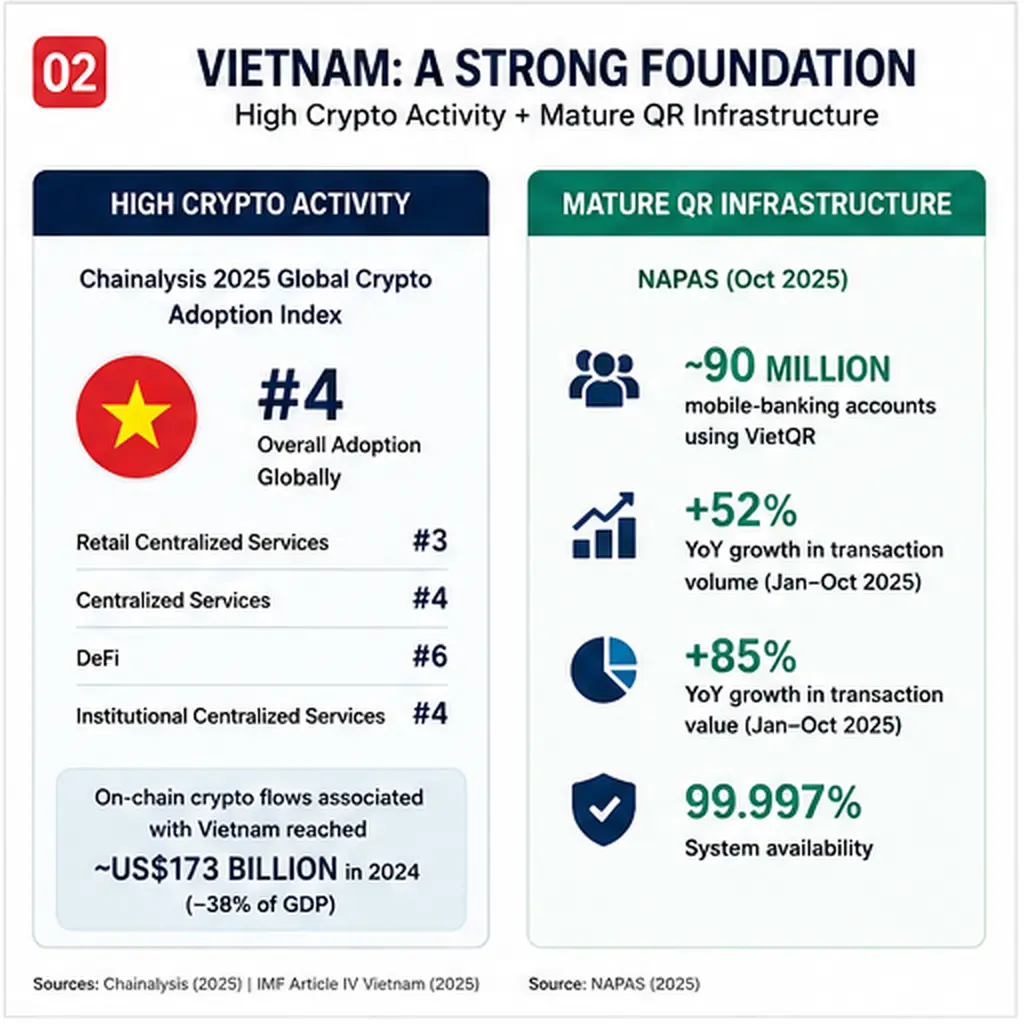
Vietnam combines high digital-asset activity with highly developed domestic QR-payment infrastructure. Chainalysis ranked Vietnam fourth globally in its 2025 Global Crypto Adoption Index. The IMF's 2025 Article IV report estimated approximately US$173 billion in gross on-chain crypto-asset flows associated with Vietnam in 2024, including about US$54 billion of stablecoin inflows and US$52 billion of outflows.
Gross on-chain flows are not the same as domestic crypto payments. They may reflect trading, savings, transfers and cross-border activity. They do, however, indicate substantial digital-asset liquidity.
On the acceptance side, NAPAS reported that nearly 90 million mobile-banking accounts could scan VietQR as of October 2025. In the first ten months of 2025, VietQR volume rose by more than 52% year-on-year and value by 85%; the wider NAPAS system processed more than 32 million transactions per day with 99.997% availability.
Vietnam's 2025 global crypto-adoption rank
Mobile-banking accounts capable of scanning VietQR
National interoperable QR infrastructure potentially removes much of the merchant side of the traditional two-sided-network problem. The go-to-market task becomes: acquire the payer, connect digital liquidity to domestic rails and let the merchant keep receiving a familiar local payment.
07 · Competitive baseline
VietQR access is increasingly reproducible.
Bybit Pay lists VietQR among its supported local QR-payment systems and says the feature is available to local and international users. Bitget's Scan to Pay supports VietQR through a third-party PSP, while Bitget Wallet has integrated VietQR into a self-custody payment experience.
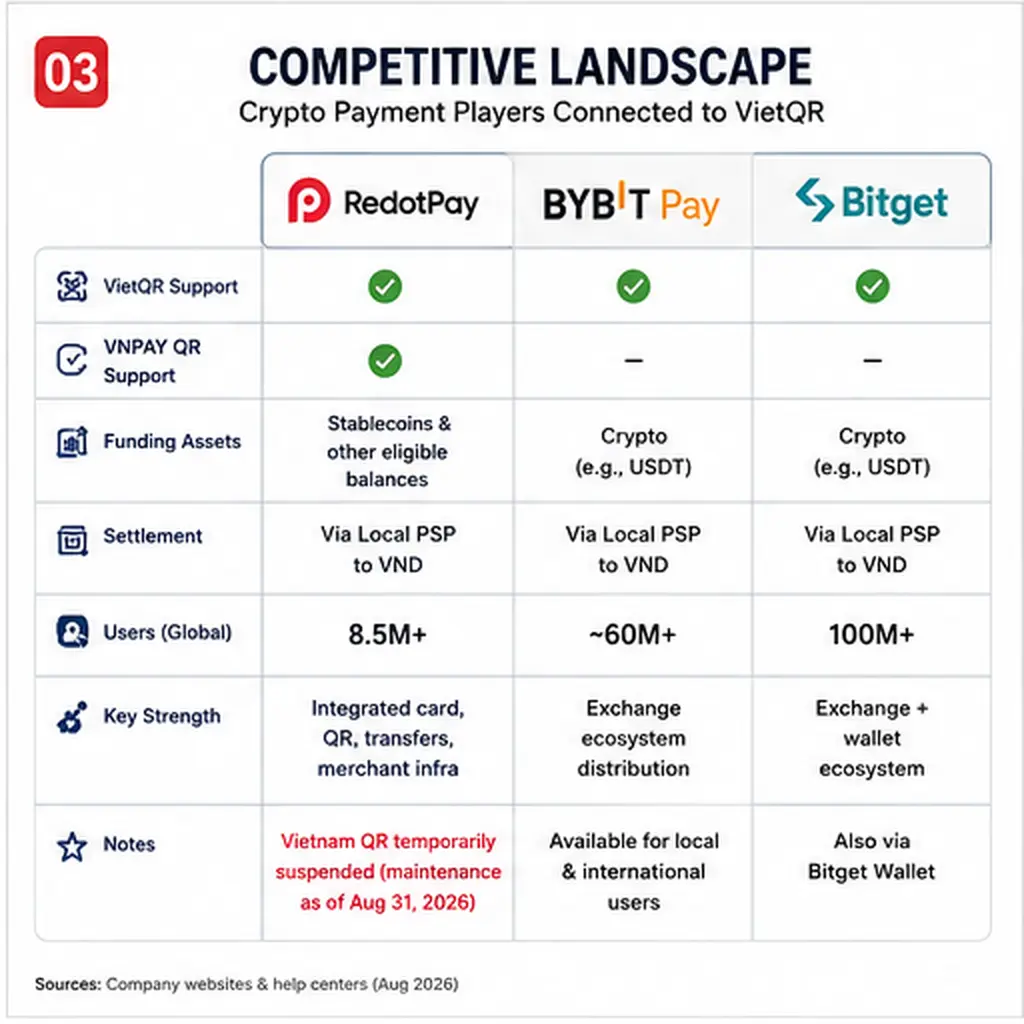
Competition moves up the stack.
BASELINE- Who owns the strongest user relationship?
- Who produces the lowest transparent conversion and settlement cost?
- Who has the most resilient local PSP architecture?
- Who delivers the highest success rate and best refund experience?
- Who creates recurring payment behavior?
08–09 · Regulatory perimeter
The question is more complex than “Is crypto payment legal?”
Resolution 05/2025/NQ-CP established a five-year pilot framework for Vietnam's crypto-asset market and provides that issuance, offering, trading and settlement within the pilot framework must be conducted in Vietnamese dong. Domestic non-cash payments sit under a separate framework, including Decree 52/2024/ND-CP.
The identity, licensing status and contractual role of RedotPay's Vietnam Local PSP are material. NEWR found no primary-source disclosure naming that provider and has not established that RedotPay has a direct partnership with NAPAS or VNPAY, or that RedotPay itself holds a Vietnamese payment or crypto-asset service licence.
RedotPay supports local Vietnamese QR standards through a Local PSP architecture disclosed in its product terms. The identity and specific regulatory role of the Vietnam PSP remain unverified in the public sources reviewed by NEWR.
Supporting VietQR or VNPAY QR does not, by itself, demonstrate a direct partnership with NAPAS or VNPAY. Routing may pass through another licensed participant or intermediary.
10–13 · Distribution opportunities
If acceptance is solved, who produces payment volume?
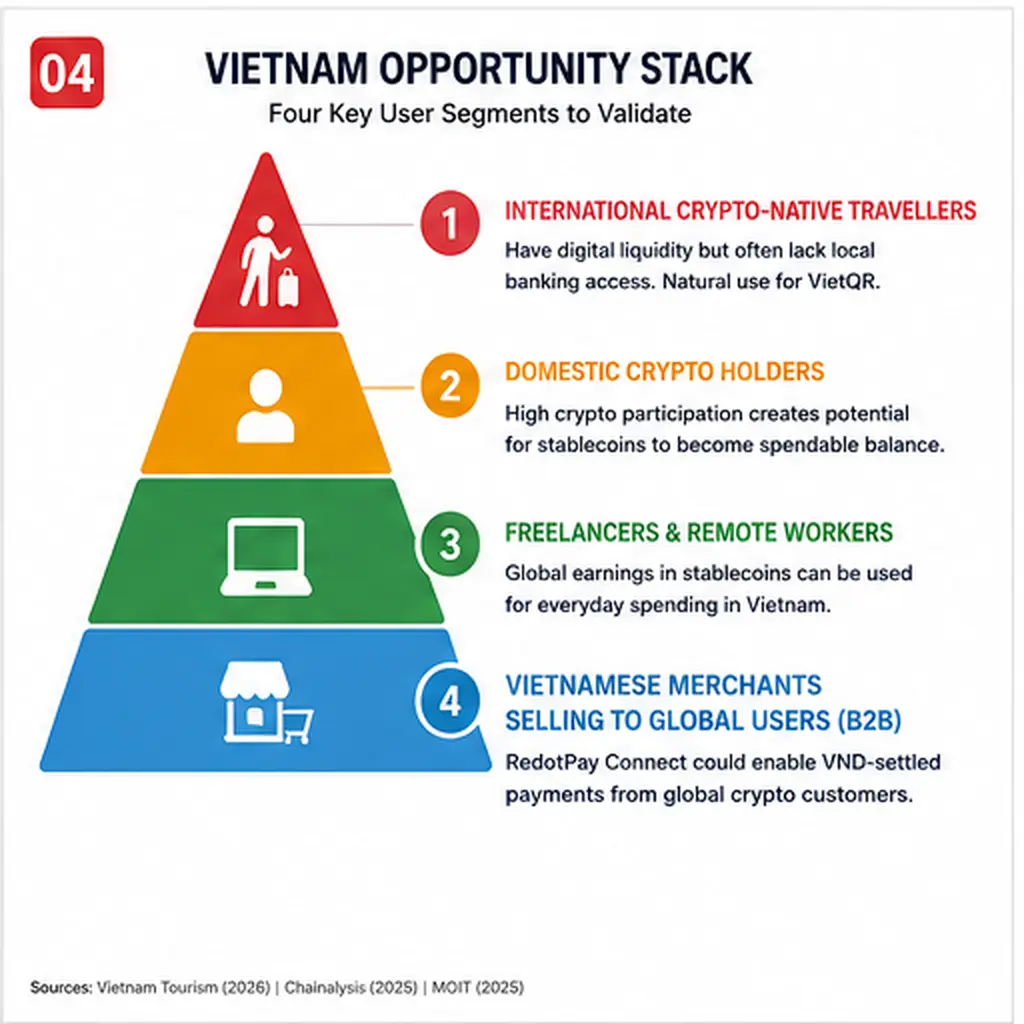
A technically functional payment product can remain marginal if users do not transact repeatedly. NEWR sees four initial segments worth testing.
International crypto-native travellers
Vietnam recorded approximately 12.25 million international visitors in H1 2026. Travellers may have liquid digital assets but no Vietnamese bank account, while merchants already understand QR.
Initial priorityDomestic crypto holders
Local QR connectivity could turn stablecoins from held assets into spendable balances. Mass-market or KOL-led acquisition remains sensitive without clearer regulatory mapping.
Freelancers and global earners
Workers paid across borders could preserve digital or dollar-linked liquidity and convert at the moment of domestic spending. Source-of-funds, remittance and FX questions require validation.
Vietnamese merchants selling globally
RedotPay Connect creates a B2B hypothesis for merchants accepting stablecoin-funded payments. Vietnam-entity onboarding and direct VND settlement are not publicly verified.
14 · Defensibility
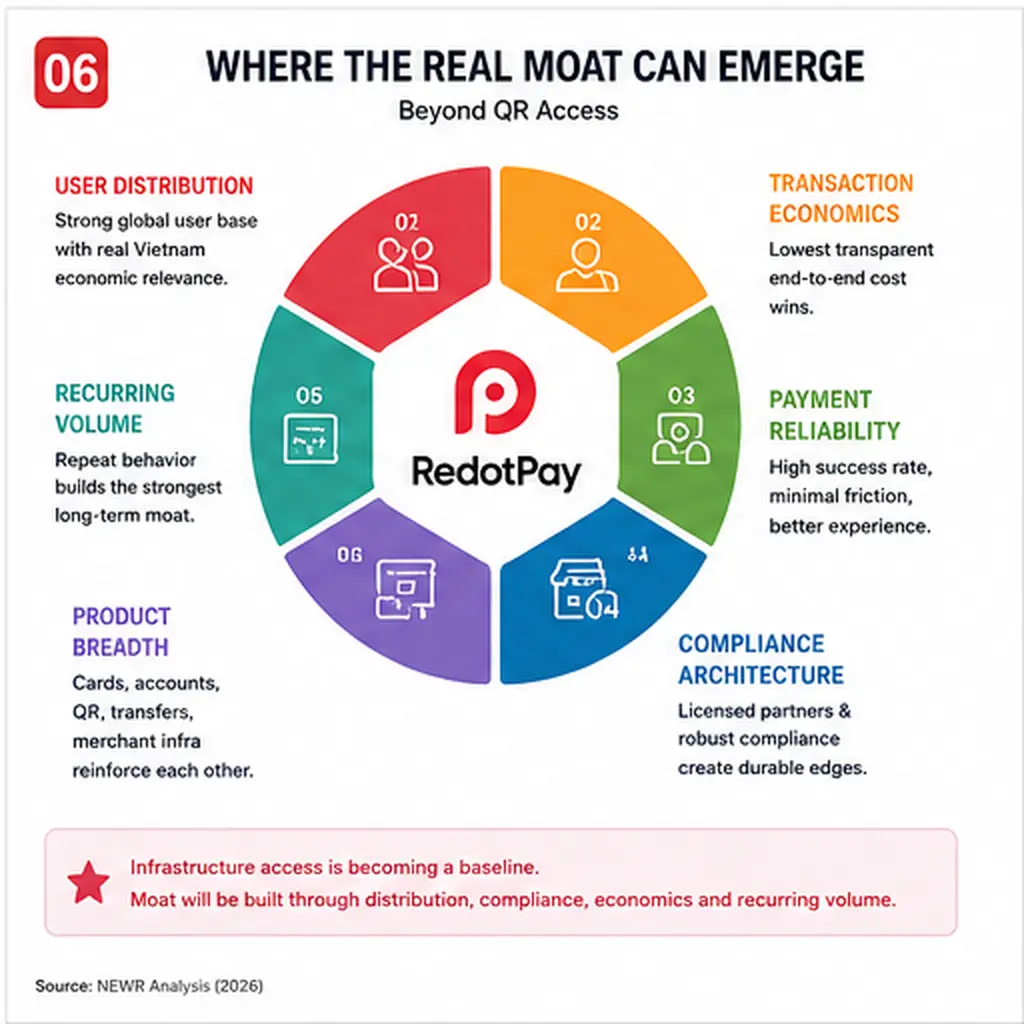
The real moat sits above the QR code.
User distribution
How many global users travel to, live in or transact with Vietnam?
Transaction economics
Token spread, FX conversion, PSP cost, handling fee and settlement economics.
Payment reliability
Success rate, confirmation time, failure recovery and partner redundancy.
Compliance architecture
Licensed PSPs, banks and compliant distribution become competitive infrastructure.
Product breadth
Cards, accounts, transfers, QR payments and merchant infrastructure can reinforce one another.
Recurring volume
The meaningful KPI is repeat payment volume per active user—not registrations.
15–17 · Validation plan
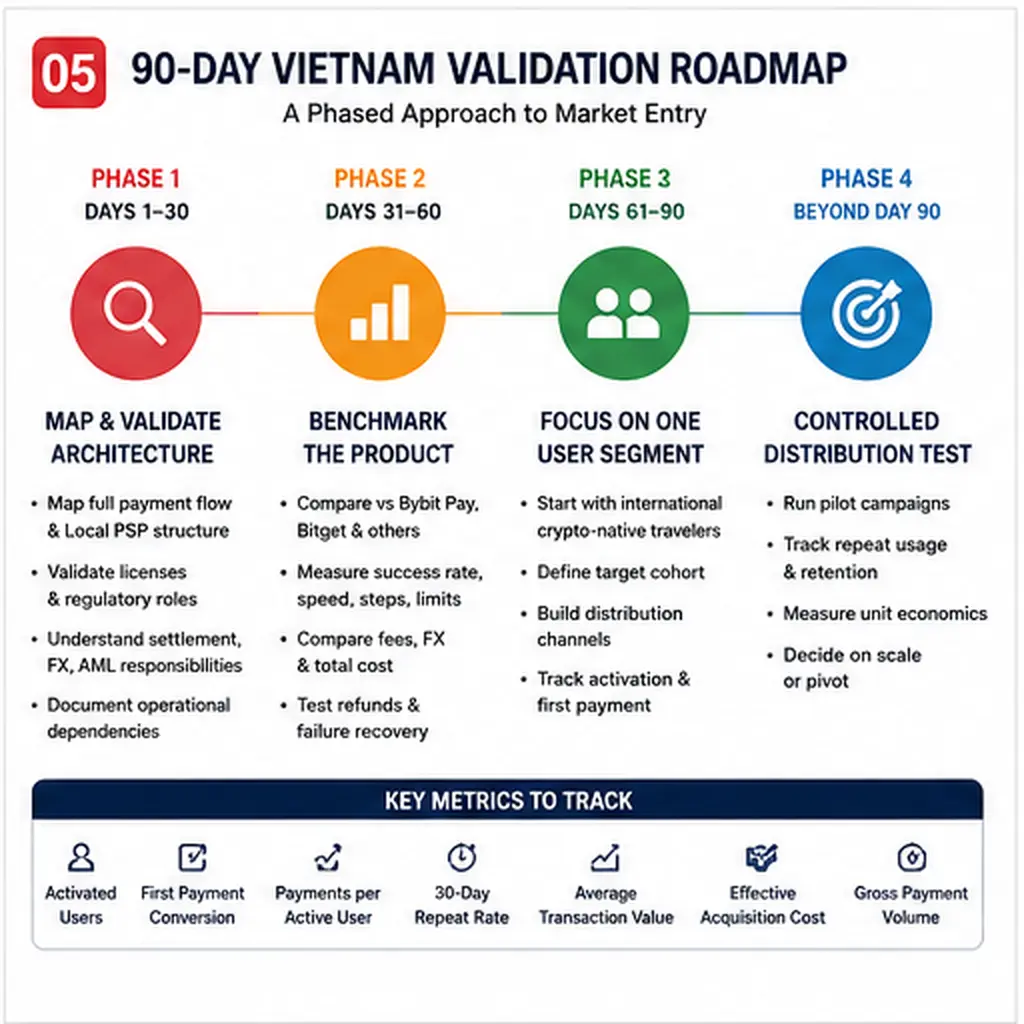
A 90-day Vietnam validation hypothesis.
NEWR would not begin with a broad launch. A controlled sequence should first reveal where operational, economic and regulatory dependencies sit.
Map the architecture
Verify entities, PSPs, licences, contracts, AML, FX, settlement, consumer protection and permitted distribution.
Benchmark the product
Compare RedotPay, Bybit Pay, Bitget and others on success, speed, QR coverage, exchange rate, total cost, recovery and refunds.
Select one segment
Start with international crypto-native travellers: digital liquidity without local banking access.
Run a controlled experiment
Track first payment, payments per user, 30-day repeat rate, average value, acquisition cost and gross volume.
What still needs proving
Ten priority research questions
- Who is the regulated Local PSP supporting Scan to Pay in Vietnam?
- Do VietQR and VNPAY QR use the same payment partner or different routing?
- What is the current success rate for Vietnamese QR payments?
- What are Vietnam monthly active users and payment volume?
- What is the mix between residents and international visitors?
- What is the effective FX and settlement cost for a typical stablecoin-funded VND payment?
- What caused the August 2026 interruption, and what PSP-level redundancy exists?
- Can Vietnam-incorporated merchants access RedotPay Connect?
- Can Connect settle Vietnamese merchants directly in VND?
- Which local distribution and promotion activities are permitted?
18 · NEWR assessment
The bridge is built. The market still has to be earned.
VALIDATEVietnam looks structurally attractive because digital liquidity, domestic payment infrastructure and conversion infrastructure are converging. Products such as RedotPay can attempt to turn stablecoins from an asset users hold into a funding layer users can spend.
But infrastructure access is only the beginning. The harder tests are user acquisition, repeated behavior, local PSP resilience, regulatory sustainability and end-to-end economics.
VietQR is RedotPay's entry point into Vietnam's payment economy. It is not the moat.
The moat, if one emerges, will be built through distribution, compliance architecture, transaction economics and recurring volume.
Vietnam Market-Entry Validation Sprint
One viable use case. One workable architecture. One measurable path.
Evaluate market demand, the regulatory perimeter, local payment rails, partner architecture, distribution and pilot economics within seven business days.
View the validation sprintResearch record
Sources
- 01
- 02RedotPay Help CenterGetting Started with Instant QR Payments ↗
- 03RedotPayScan to Pay Terms & Conditions ↗
- 04RedotPay Help CenterQR Payments to Vietnam Merchants Are Temporarily Paused ↗
- 05
- 06
- 07
- 08RedotPayGeneral Terms of Service ↗
- 09Government of VietnamResolution 05/2025/NQ-CP on the pilot crypto-asset market ↗
- 10Government of VietnamDecree 52/2024/ND-CP on non-cash payments ↗
- 11
- 12Vietnam National Authority of TourismInternational visitor statistics, H1 2026 ↗
- 13Vietnam Ministry of Industry and TradeDigital technology paves the way for e-commerce growth ↗
- 14Chainalysis2025 Global Crypto Adoption Index ↗
- 15International Monetary FundVietnam: 2025 Article IV Consultation ↗
- 16Bybit PayQR Pay and Bank Transfer FAQ ↗
- 17
- 18Bitget WalletNational QR code payment support ↗
Research cut-off: 31 August 2026.