
Stablecoins · Payment infrastructure · Regulation · Vietnam
Vietnam Stablecoin Market 2026: infrastructure is moving faster than regulation.
Vietnam already has deep crypto liquidity, mature domestic payment infrastructure and an increasing number of stablecoin products touching VND and local payment rails. The opportunity is not another crypto app—it is the compliant bridge to the right regulated local financial layer.

01 · Digital-dollar liquidity
Vietnam does not lack crypto users.
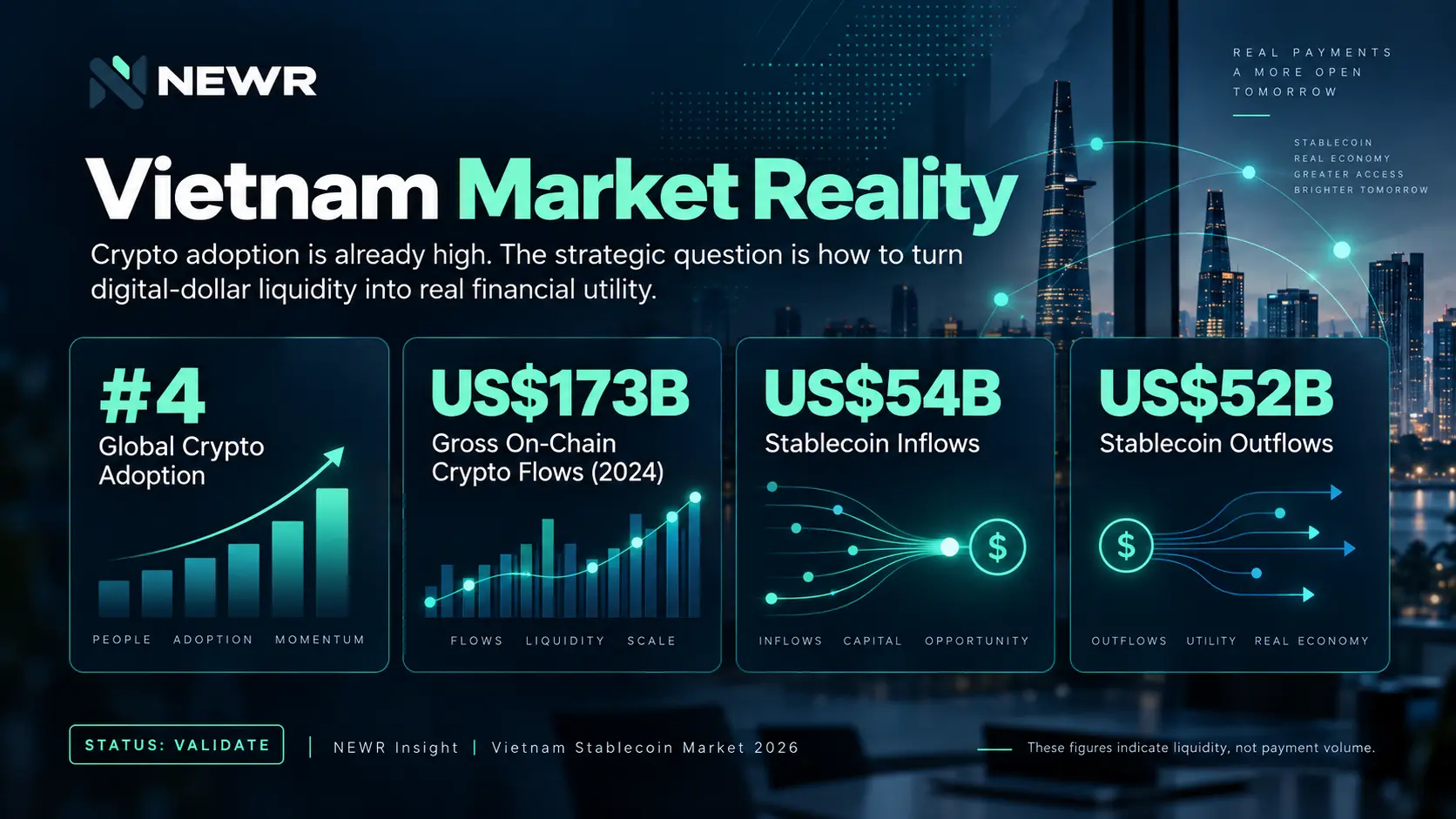
Vietnam ranked fourth globally in Chainalysis' 2025 Global Crypto Adoption Index. The IMF estimated that gross on-chain crypto-asset flows associated with Vietnam reached approximately US$173 billion in 2024, including about US$54 billion in gross stablecoin inflows and US$52 billion in gross outflows.
These figures are not payment volume. They may include trading, transfers, store-of-value activity, cross-border flows, DeFi and settlement between wallets or exchanges.
The data nevertheless indicates substantial digital-dollar liquidity. The strategic challenge is converting part of that liquidity into compliant financial utility.
02 · Existing payment infrastructure
Vietnam's fiat payment layer is already highly developed.
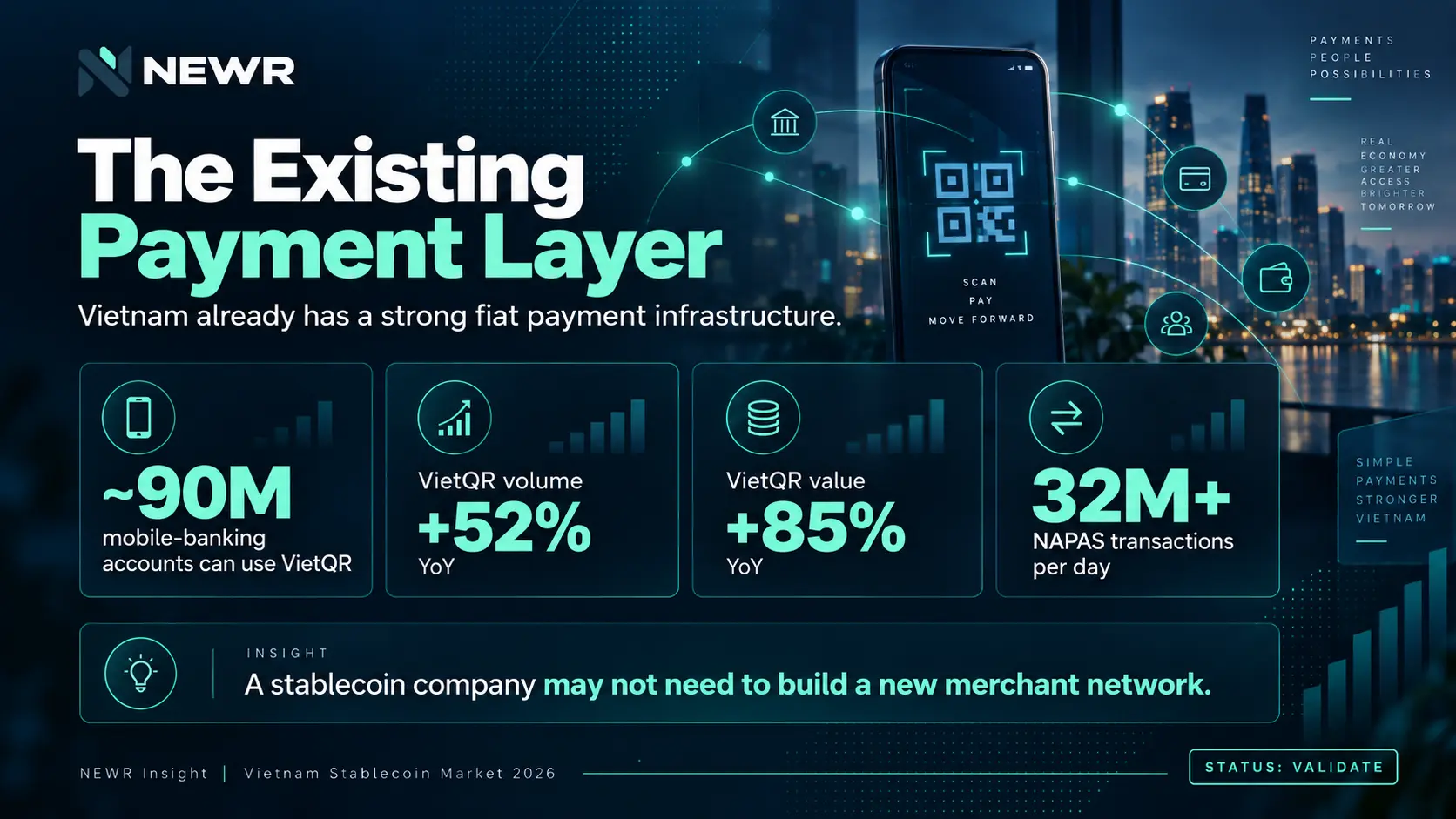
NAPAS reported that by October 2025, nearly 90 million mobile-banking accounts could scan VietQR. In the first ten months of 2025, VietQR transaction volume grew more than 52% year-on-year and transaction value rose 85%. The NAPAS system processed more than 32 million transactions per day on average.
Cross-border QR connectivity has also expanded. NAPAS describes connections with Thailand, Cambodia, Laos and China, with South Korea and Singapore services launched in 2026.
A stablecoin company may not need another merchant network. It may need to connect digital liquidity to the network that already exists.
03 · Product-layer signal
Stablecoin-funded VietQR experiences are already appearing.
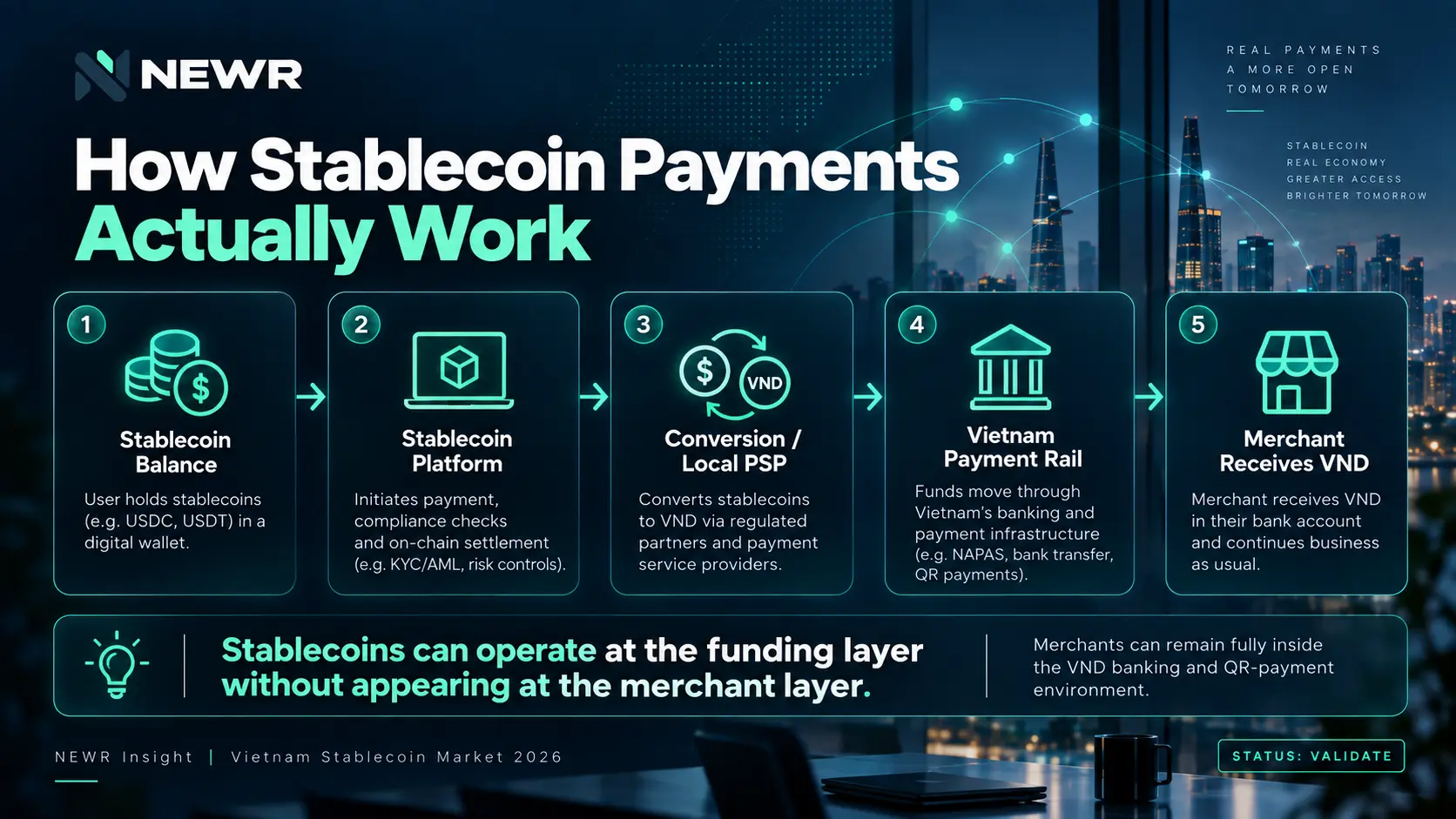
RedotPay, Bybit Pay and Bitget Wallet have each published product material describing crypto- or stablecoin-funded payment experiences that support VietQR in Vietnam. This does not necessarily mean that a merchant receives USDT, or that the platform has a direct relationship with NAPAS.
Stablecoins can therefore sit in the funding layer while remaining invisible to the merchant. Availability, limits and eligible users can change by provider and should be confirmed before any commercial reliance.
04 · Regulatory perimeter
Infrastructure is moving faster than regulatory certainty.
Resolution 05/2025/NQ-CP established a five-year pilot for Vietnam's crypto-asset market. Activities covered by the pilot are routed through licensed organizations in Vietnam; issuance, trading and settlement under the pilot are conducted in VND; and advertising and marketing are restricted to authorized organizations.
A Vietnamese company applying for a licence to organize a crypto-asset trading market must meet a minimum charter-capital requirement of VND 10 trillion. This does not mean every foreign stablecoin or fintech company evaluating Vietnam needs VND 10 trillion.
The key question is which activity each party performs within the transaction stack, and whether that activity requires a locally licensed entity. This publication is market analysis, not legal advice.
05 · The missing layer
The commercial gap is the regulated local partner.
Most international stablecoin infrastructure companies are strongest in routing, conversion, orchestration, custody, privacy or settlement technology. Vietnam is already developed on the fiat-infrastructure and distribution side. The opportunity is connecting the systems.
Digital liquidity
USDT, USDC and other crypto balances.
Stablecoin infrastructure
Wallets, routing, conversion, orchestration, settlement, privacy and custody.
Regulated local infrastructure
Banks, PSPs, remittance providers, financial institutions and future licensed digital-asset operators.
Distribution
Merchants, enterprises, workers, travellers, SMEs and platform users.
06 · Priority opportunities
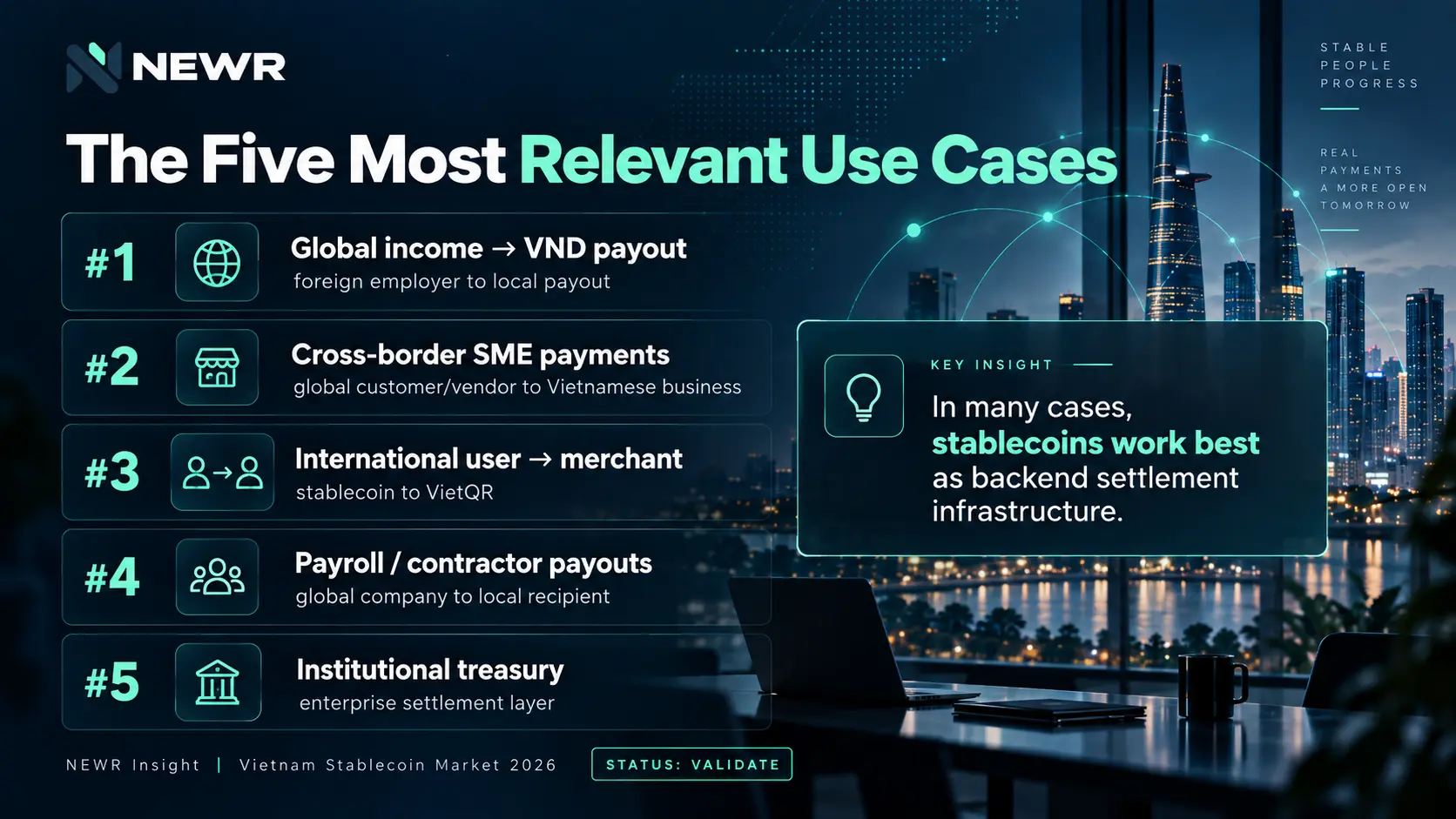
Five use cases worth validating, ranked by near-term feasibility.
Global income → VND payout
Foreign employer or client → USD or stablecoin rail → local payout → Vietnamese recipient.
Cross-border SME payments
Global customer or vendor → stablecoin settlement → Vietnamese business.
International user → merchant
Stablecoin balance → conversion → VietQR → merchant receives VND.
Payroll and contractor payouts
Global company → stablecoin infrastructure → employee or contractor receives local currency.
Institutional treasury
Bank, fintech or enterprise → stablecoin settlement layer → regulated financial endpoint.
The first three flows may be easier to validate in the near term. Institutional treasury can be strategically important, but usually carries longer sales cycles and a more demanding regulatory process.
07 · Entry guardrails
What should not be done first.
Mass retail acquisition
Do not default to a KOL, referral and retail-acquisition playbook while the marketing perimeter remains sensitive.
Treating VietQR support as a licence
“Supports VietQR” does not prove a direct NAPAS partnership or authorization to operate a crypto-payment service.
Asking merchants to hold stablecoins
Merchants already use VND, bank accounts and QR. A new flow should not force them to take on wallets, private keys or crypto-specific compliance.
The strongest infrastructure may remain invisible in the merchant experience.
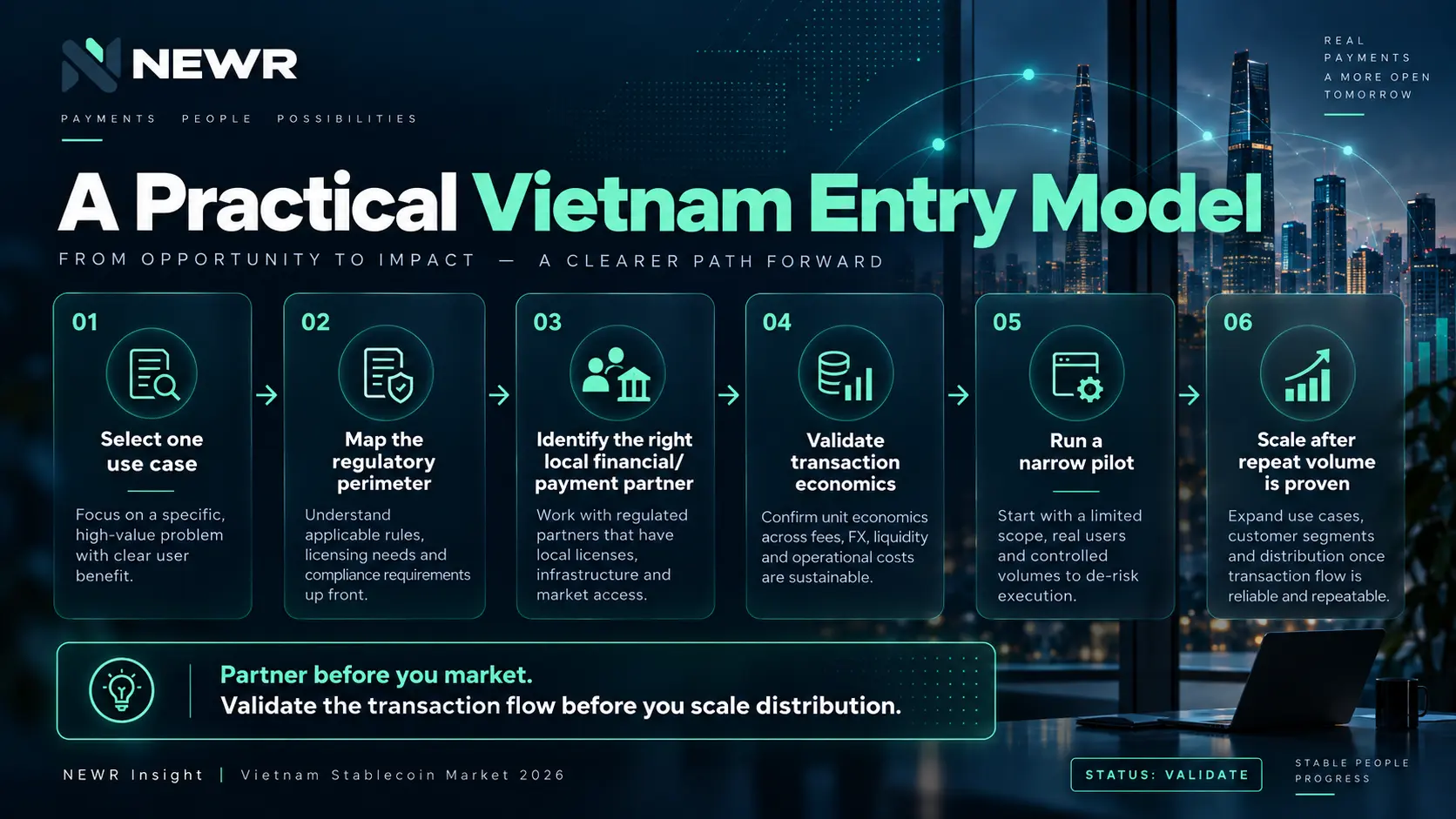
08 · Practical entry model
Partner before market. Validate the transaction before scaling distribution.
Foreign stablecoin company → app launch → KOL campaign → users
Use case → regulatory perimeter → local partner → economics → narrow pilot → repeat volume
One example is a global payout platform connecting through a Vietnamese PSP or bank so a contractor receives VND. Another is a stablecoin wallet using licensed payment infrastructure so an international traveller can pay a VietQR merchant.
09 · NEWR assessment
Build the compliant bridge—not another stablecoin app.
VALIDATEVietnam does not lack crypto users or merchant payment infrastructure. The missing layer is a compliant bridge between digital-dollar liquidity and regulated financial rails.
Vietnam does not need another stablecoin app. It needs better infrastructure connecting stablecoins to banks, PSPs, businesses and existing payment rails.
The sharper entry question is not “How many users can this company acquire?” It is “What local financial layer does this company still need?”
Vietnam Market-Entry Validation Sprint
One use case. One partner architecture. One entry decision.
Validate the regulatory perimeter, partner model, transaction economics and pilot path within seven business days.
View the validation sprintResearch record
Sources
- 01
- 02International Monetary FundVietnam: 2025 Article IV Consultation — crypto-asset and stablecoin flow estimates ↗
- 03
- 04
- 05
- 06
- 07
- 08
- 09Bitget WalletNational QR payments, including VietQR in Vietnam ↗
Research cut-off: 7 September 2026.