
NEWR Observation · Emerging Stack Series
7 Companies, 2 Weeks, One Emerging Stack: Stablecoins Are Becoming Financial Infrastructure
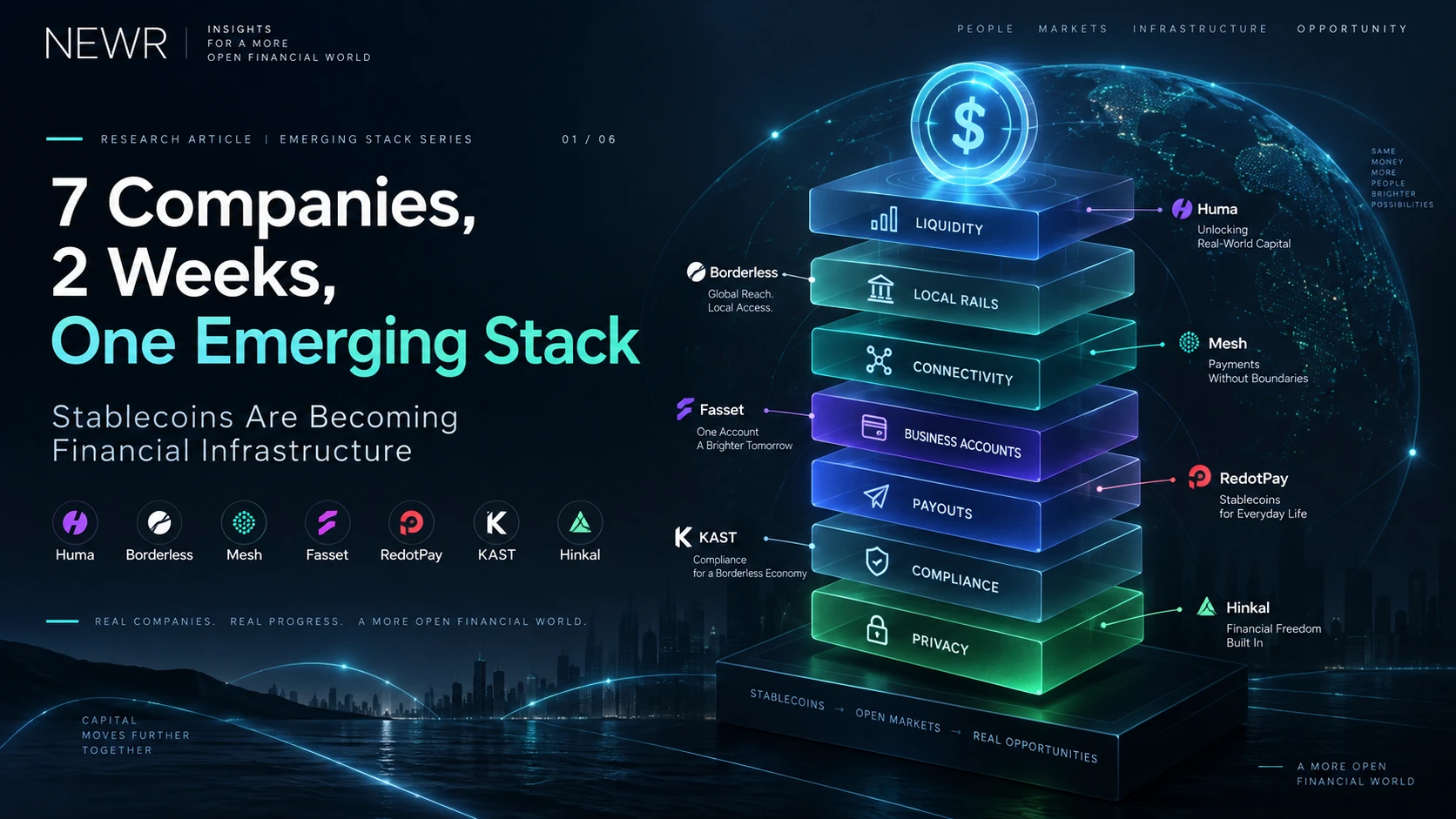
From liquidity and orchestration to business accounts, payouts, compliance, and privacy, the stablecoin market is starting to look less like crypto — and more like a new financial operating stack.
The emerging pattern
Different companies. Increasingly connected layers.
Over the past two weeks, NEWR has been tracking seven companies building across different layers of the stablecoin ecosystem.
Individually, they look quite different.
- Huma finances liquidity for payment flows.
- Borderless orchestrates local payment rails.
- Mesh connects wallets, exchanges, and payment platforms.
- Fasset, RedotPay, and KAST bring stablecoins closer to users and businesses.
- Hinkal addresses confidentiality once real financial activity starts moving on-chain.
But their latest developments point toward a much bigger pattern:
They are increasingly becoming different layers of the same financial stack.
“Two weeks” describes NEWR’s research window, not a claim that every product launched during that period. Figures below are company-reported snapshots. The stack is NEWR’s analytical framework, not a joint product or partnership among all seven companies.
01 · Borderless.xyz
Expanding Deeper Into Local Rails
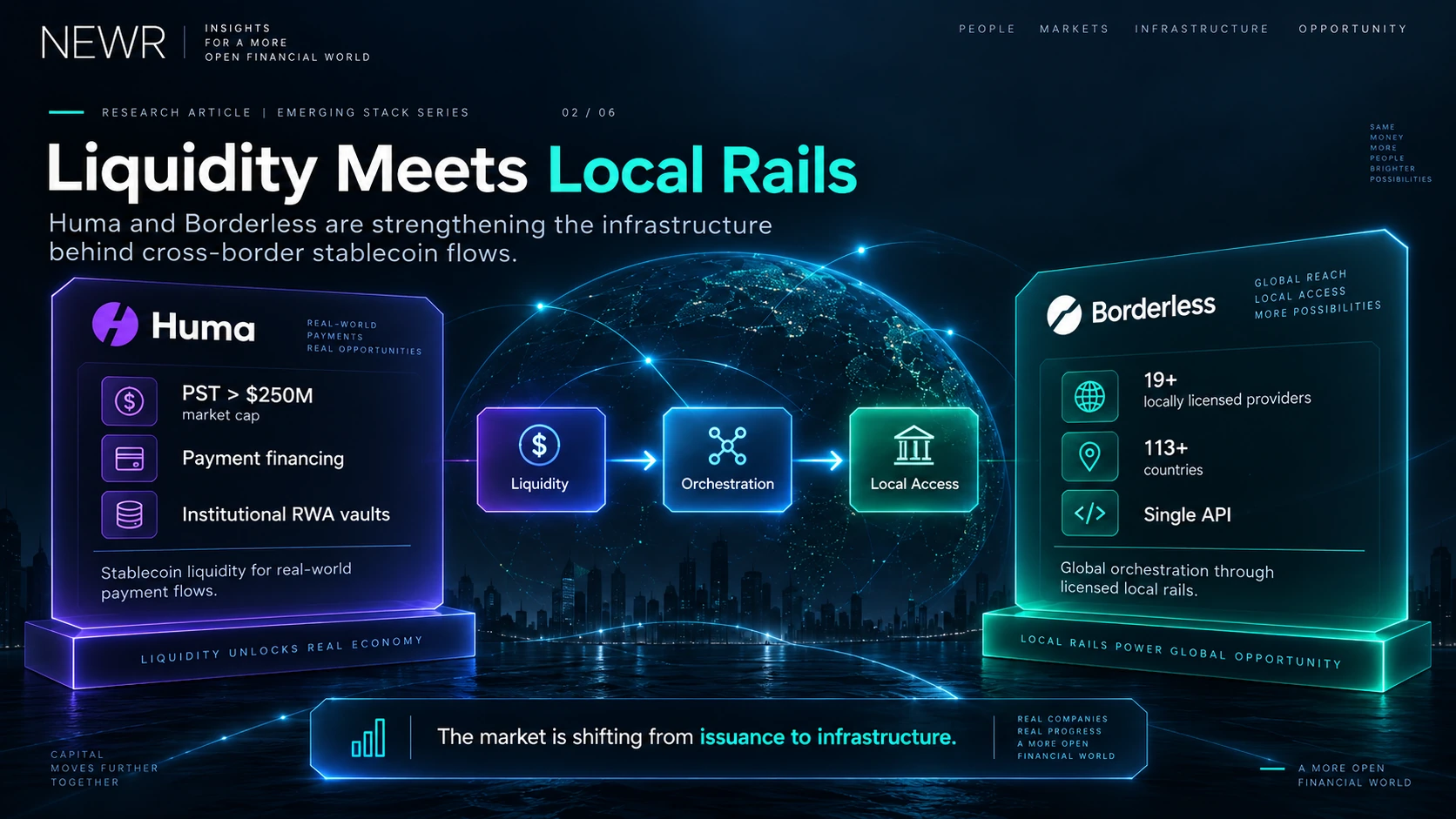
On September 3, Tazapay’s launch on the Borderless network was announced. The integration adds local collection and payout capabilities across nine markets in APAC and LATAM. Borderless says its network now connects 19+ locally licensed providers across more than 113 countries through a single API. [1] [2]
The important point is not simply the addition of nine markets. It reinforces the broader Borderless thesis:
Global stablecoin infrastructure does not need to rebuild banking and payment rails country by country. It can orchestrate licensed local providers that already exist.
This is highly relevant to Vietnam. Rather than replacing domestic payment infrastructure, foreign stablecoin companies may be better positioned by connecting to a licensed local financial layer.
The Borderless blog is dated September 2; its distributed launch announcement is dated September 3, 2026.
Read NEWR’s Borderless Vietnam Insight02 · Huma
PayFi Is Moving Toward Institutional Credit Infrastructure
Huma has shown several signs of increasing institutionalization.
Sentora launched a dedicated Huma PST Vault on Morpho, giving allocators access to payment-financing yield through PYUSD. [3]
PST has also appeared inside the Bitwise Premium RWA Vault, with Bitwise curating acceptable collateral and risk parameters. Huma recently reported that PST had surpassed US$250 million in market capitalization. [4] [5]
This represents an important evolution. The original Huma thesis was:
That liquidity is now increasingly being packaged as:
PayFi is therefore beginning to look less like a DeFi narrative and more like a potential institutional credit market.
03 · RedotPay
From Growth Toward Compliance Maturity
In our previous analysis of RedotPay, NEWR asked:
If VietQR is becoming available across multiple stablecoin apps, where does the moat move next?
One possible answer is increasingly clear: trust and regulatory infrastructure.
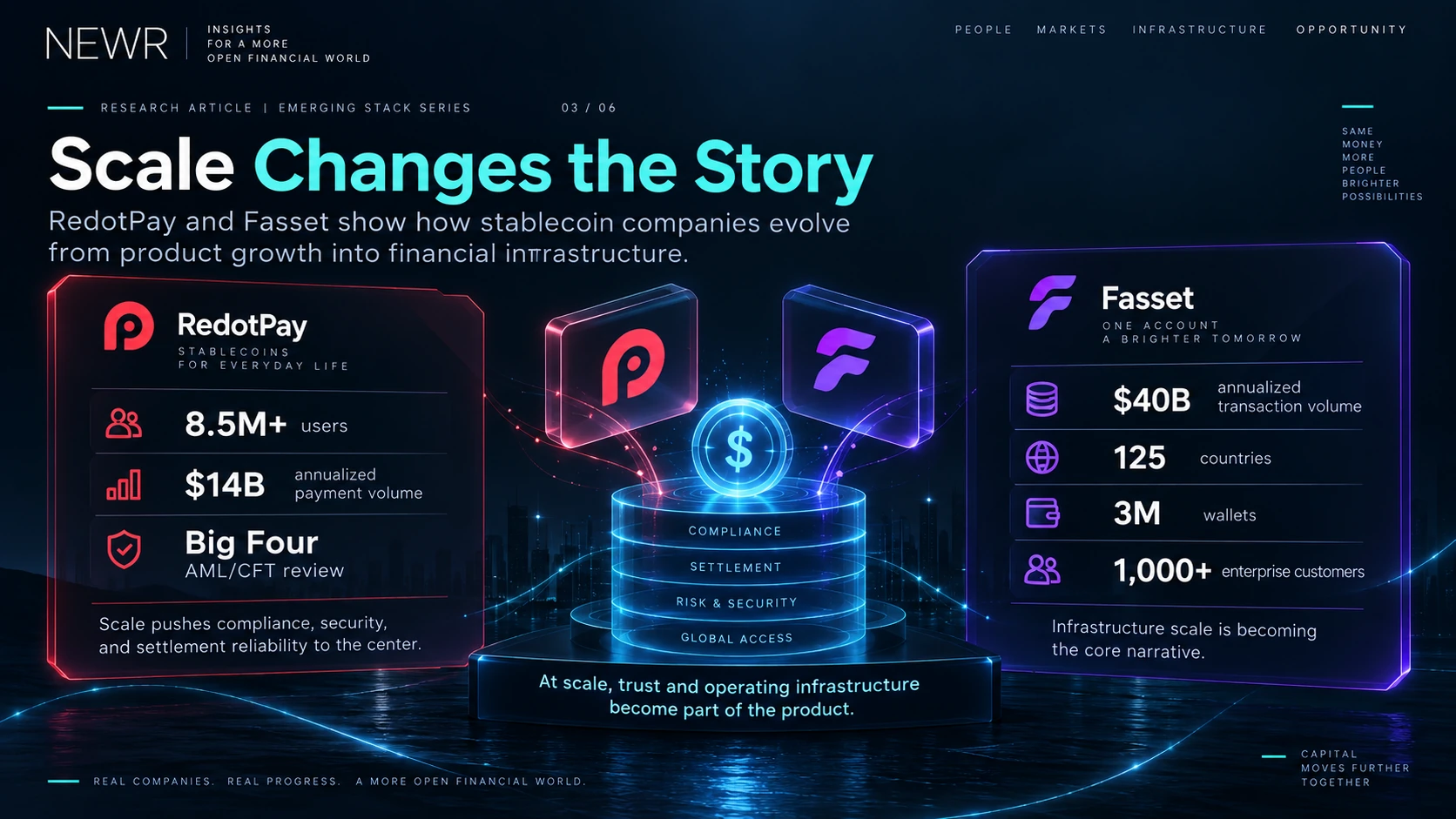
On September 7, RedotPay announced that it had completed an independent AML/CFT review by a Big Four firm. The review covered governance, customer due diligence, transaction monitoring, and internal controls across its licensed Hong Kong subsidiaries. [6]
The figures cited in NEWR’s research are more than 8.5 million users across 100 countries and approximately US$14 billion in annualized payment volume.
Source note: these scale figures are retained from NEWR’s research and supplied graphic. RedotPay’s About page checked on September 9 instead displays 8M+ users, 100+ countries and US$12B annualized volume. The newer US$14B figure was not independently corroborated in the sources reviewed. The AML/CFT announcement confirms the review, not these scale metrics. [7]
At this scale, competitive advantage can no longer come only from offering a card or QR-payment functionality.
Compliance, security, licensing, and settlement reliability increasingly become part of the product itself.Read NEWR’s RedotPay Vietnam Insight
04 · Fasset
Infrastructure Scale Is Becoming the Bigger Story
Fasset announced its US$68 million Series C in late August. But what is more important than the funding itself is the scale the company is now reporting around its infrastructure.
Fasset says it processes more than US$40 billion in annualized transaction volume, serving approximately 3 million wallets and more than 1,000 enterprise customers across 125 countries. Own Network underpins this broader financial infrastructure. [8]
The Series C valued Fasset at US$1 billion, while total capital raised during 2026 reached US$119 million. The new funding is being directed toward Own Network and AI infrastructure supporting settlement, tokenization, and corridor banking.
The strategic direction is increasingly clear:
Fasset is becoming less like a crypto investment application and more like a financial network and operating layer.
Its positioning — “Any person. Any asset. Any rail. Anywhere.” — reflects that shift.
05 · Mesh
Orchestration Is Starting to Produce Measurable Proof
Mesh recently produced two particularly useful proof points.
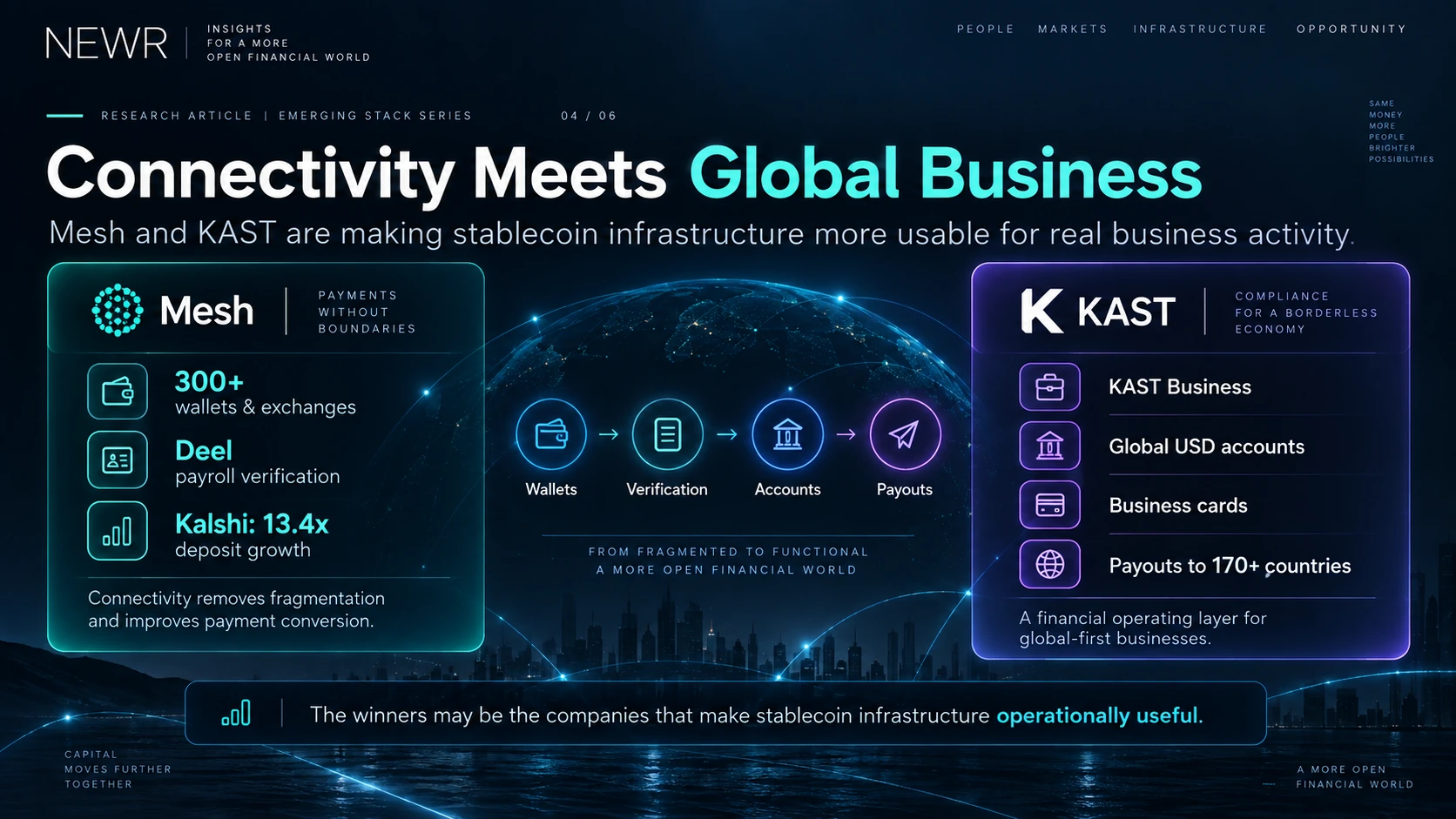
With Deel, Mesh provides wallet-ownership verification for stablecoin payroll. Recipients can connect one of more than 300 supported wallets and exchanges and verify ownership before payments are sent. [9]
With Kalshi, Mesh reported significant growth after consolidating crypto deposit flows through its infrastructure:
- Monthly crypto deposits increased 13.4×.
- Active depositors increased 17×.
- Deposit paths expanded from 3 to 30 combinations.
- Cumulative deposit volume surpassed nine figures.
Mesh’s August 2026 case study describes a ten-month period after launch; the monthly deposit and depositor metrics peaked in July 2026. These are Mesh-reported outcomes, not an independent causal evaluation. [10]
This strengthens a thesis NEWR previously highlighted:
Mesh does not need to own the merchant or the end-user distribution. It creates value by connecting what users already have with the financial rail a platform needs.
Infrastructure itself can become a growth engine when it removes fragmentation.
Read NEWR’s Mesh distribution Insight06 · KAST
The “Global-First Business” Thesis Is Being Product-Validated
This may be one of the most interesting developments relative to our recent research.
NEWR recently created the KAST × Vietnam — Global-First Business Opportunity Map around a simple thesis: KAST should not look at Vietnam only through crypto consumers.
The more interesting segment may be businesses that:
KAST has formally launched KAST Business. The product includes:
- Global USD accounts
- Business and team cards
- Cashback
- Payouts to teams across 170+ countries, subject to market eligibility
- Unified business financial management
This strongly supports the direction of our earlier research:
KAST is evolving from a stablecoin consumer neobank toward a financial operating platform for global businesses.
For Vietnam, the relevant question becomes increasingly specific:
Which Vietnamese businesses already operate globally enough for KAST Business to create immediate operational value?
The launch supports product-direction fit; it does not establish Vietnamese customer demand or universal account eligibility. KAST’s launch campaign began September 2, so this observation should not be read as a claim that NEWR’s September map preceded the launch.
07 · Hinkal
Privacy Is Becoming an Infrastructure Layer
NEWR did not identify a major Hinkal product launch during the same period comparable to KAST or Borderless. But its positioning has become increasingly consistent.
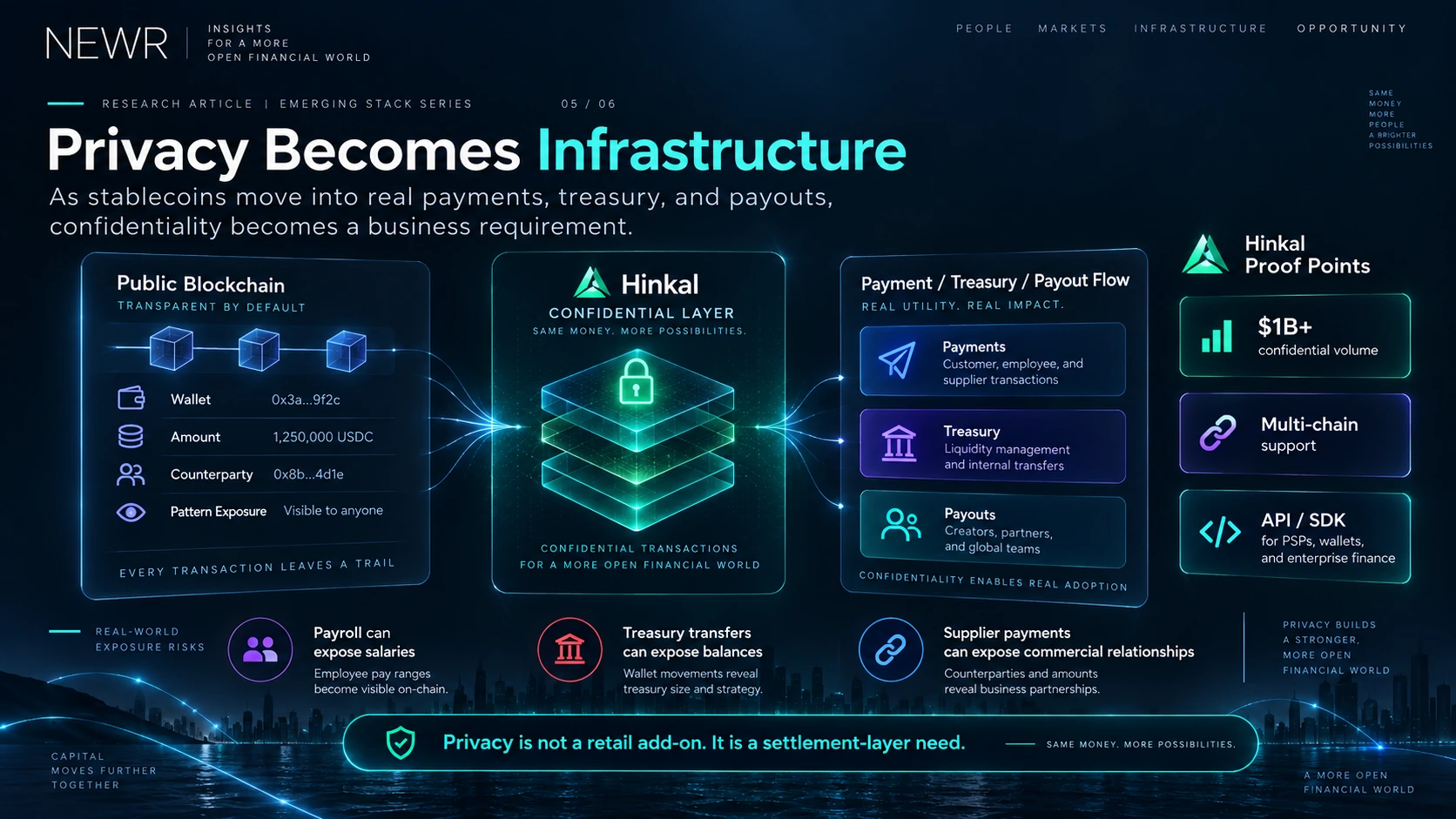
Hinkal describes itself as providing “Universal Privacy for Stablecoins”, with more than US$1 billion in confidential volume, multi-chain support, and APIs/SDKs targeting PSPs, wallets, OTC desks, neobanks, and enterprise finance. [13] [14]
Its recent messaging repeatedly highlights the same operational issue:
- Payroll can expose salaries.
- Treasury transfers can expose balances.
- Supplier payments can expose commercial relationships.
The solution is not necessarily to move companies onto a privacy-specific blockchain. Instead, privacy can be inserted into the existing wallet, custody, and settlement stack.
This aligns directly with NEWR’s recent Vietnam conclusion:
The likely privacy buyer is the company controlling the on-chain stablecoin leg — not necessarily the local fiat endpoint.
The architecture
Seven Companies, One Stack
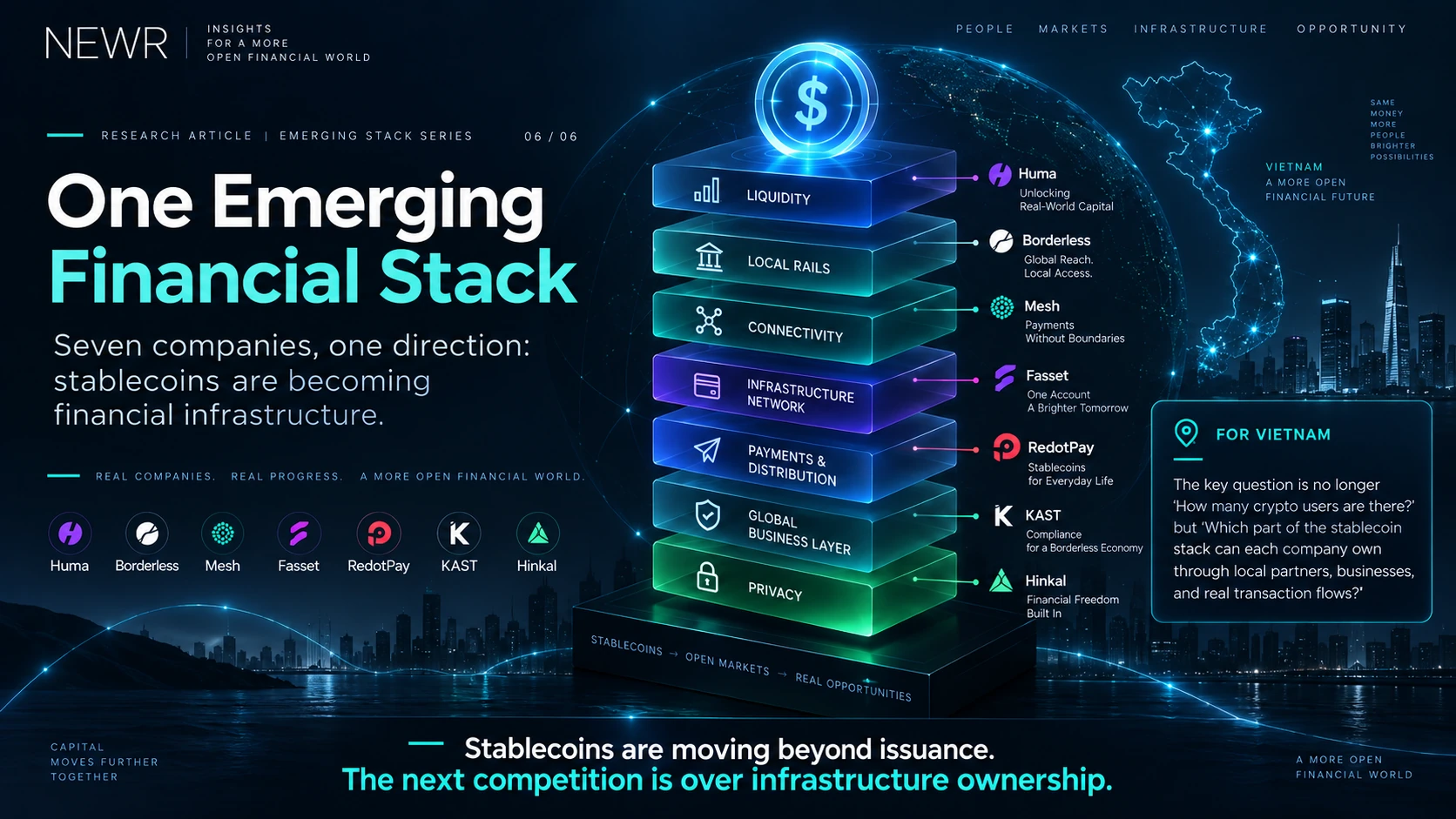
When viewed together, the seven companies begin to form a surprisingly coherent architecture.
- Huma
- Liquidity and payment financing
- Borderless
- Cross-border orchestration and local financial rails
- Mesh
- Wallet, exchange, verification, and payment connectivity
- Fasset
- Global account, asset, and settlement network
- RedotPay
- Consumer payment distribution and local merchant rails
- KAST
- Global consumer and business financial operating layer
- Hinkal
- Confidentiality for on-chain settlement
The broader conclusion is:
The stablecoin race is moving beyond issuance. The next competition is over who owns the infrastructure between digital-dollar liquidity and real-world financial activity.
Vietnam market implications
What This Means for Vietnam
For Vietnam, two weeks of research have made the thesis clearer rather than fundamentally changing it.
Vietnam does not necessarily need another stablecoin or another crypto app.
The bigger opportunity is connecting:
Each of the seven companies NEWR has been following is attempting to own a different part of that chain.
The most useful market-entry question is therefore changing. It is no longer simply:
How many crypto users are in Vietnam?
It is:
Which part of the stablecoin financial stack can this company own in Vietnam — and which local partners, businesses, and transaction flows already make that layer economically useful?
That may be the most useful framework for evaluating the next generation of stablecoin companies entering Vietnam.
Read Vietnam Stablecoin Market 2026NEWR Observation — September 2026
Independent market analysis. NEWR does not represent any of the companies referenced above.
Research record
Sources
- 01Borderless.xyzTazapay joins the network · 2 September 2026 ↗
- 02Borderless / FinanceWireTazapay launch announcement · 3 September 2026 ↗
- 03
- 04
- 05
- 06
- 07
- 08
- 09
- 10
- 11
- 12
- 13
- 14
Sources checked September 9, 2026. Reported figures are snapshots with different definitions and measurement periods; they should not be added together or treated as directly comparable. Vietnam use cases and the combined-stack interpretation are NEWR hypotheses.